
Horse breed
Maremmano
The Maremmano is an ancient breed originating from Maremma, a coastal region of Tuscany and Lazio in Italy. Its ancestors include local horses, oriental horses imported during barbarian invasions and crusades, as well as contributions from Neapolitan and Spanish horses.

The breed at a glance
The Maremmano is renowned for its calm, courageous, and willing temperament. It is an intelligent, loyal, and very hardy horse, endowed with a great capacity for learning and a strong aptitude for work, particularly with cattle.
- Category
- hardy breed
- Origin
- Italy · Antiquity / Middle Ages (established in the 19th century)
- Height at withers
- 155–165 cm
- Weight
- 500–600 kg
- Lifespan
- 25-30 years
- Common coats
- bay, chestnut, black, grey
- Disciplines
- TREC, Endurance, Working equitation, Dressage (amateur level)
- Other names
- Cheval de la Maremme, Maremma Horse
Origin and history
The Maremmano is an ancient breed originating from Maremma, a coastal region of Tuscany and Lazio in Italy. Its ancestors include local horses, oriental horses imported during barbarian invasions and crusades, as well as contributions from Neapolitan and Spanish horses. The breed was shaped by its harsh environment and its use by the butteri (Italian cowboys) for cattle work. The studbook was established in 1926, aiming to preserve and improve its qualities.

Conformation and physique
It is a horse of mesoline to sub-brachyline conformation, robust and powerful, with strong bone structure and well-developed musculature. It presents a harmonious silhouette, typical of hardy working horses.
The head is rather long, with a straight or slightly convex (Roman nose) profile. The forehead is broad, the eyes lively and expressive, the ears medium-sized and well-set. The nostrils are wide.
The neck is strong, muscular, and well-set, often arched in stallions, connecting to a well-defined and muscular wither.
The back is short and strong, the topline is taut and muscular. The chest is broad and deep, the ribs well-sprung. The croup is long, broad, and slightly sloping, with a well-set tail.
The limbs are strong, with large and well-defined joints. The cannons are short and strong, the tendons clean. The feet are large, round, and very hard, adapted to difficult terrain. Feathering is sparse.
- Common coats: bay, chestnut, black, grey
Temperament and aptitudes
The Maremmano is renowned for its calm, courageous, and willing temperament. It is an intelligent, loyal, and very hardy horse, endowed with a great capacity for learning and a strong aptitude for work, particularly with cattle.
The gaits are ample, regular, and energetic, with an extended walk, a supple trot, and a balanced canter. They are characterized by their endurance and their ability to cover long distances over varied terrain.
- Uses: Cattle work (historical and current by the butteri), Equestrian trekking, Equestrian tourism, Recreational riding, Driving, Mount for police and army (historically), Hunting with hounds
- Disciplines: TREC, Endurance, Working equitation, Dressage (amateur level), Show jumping (amateur level)
Feeding the Maremmano
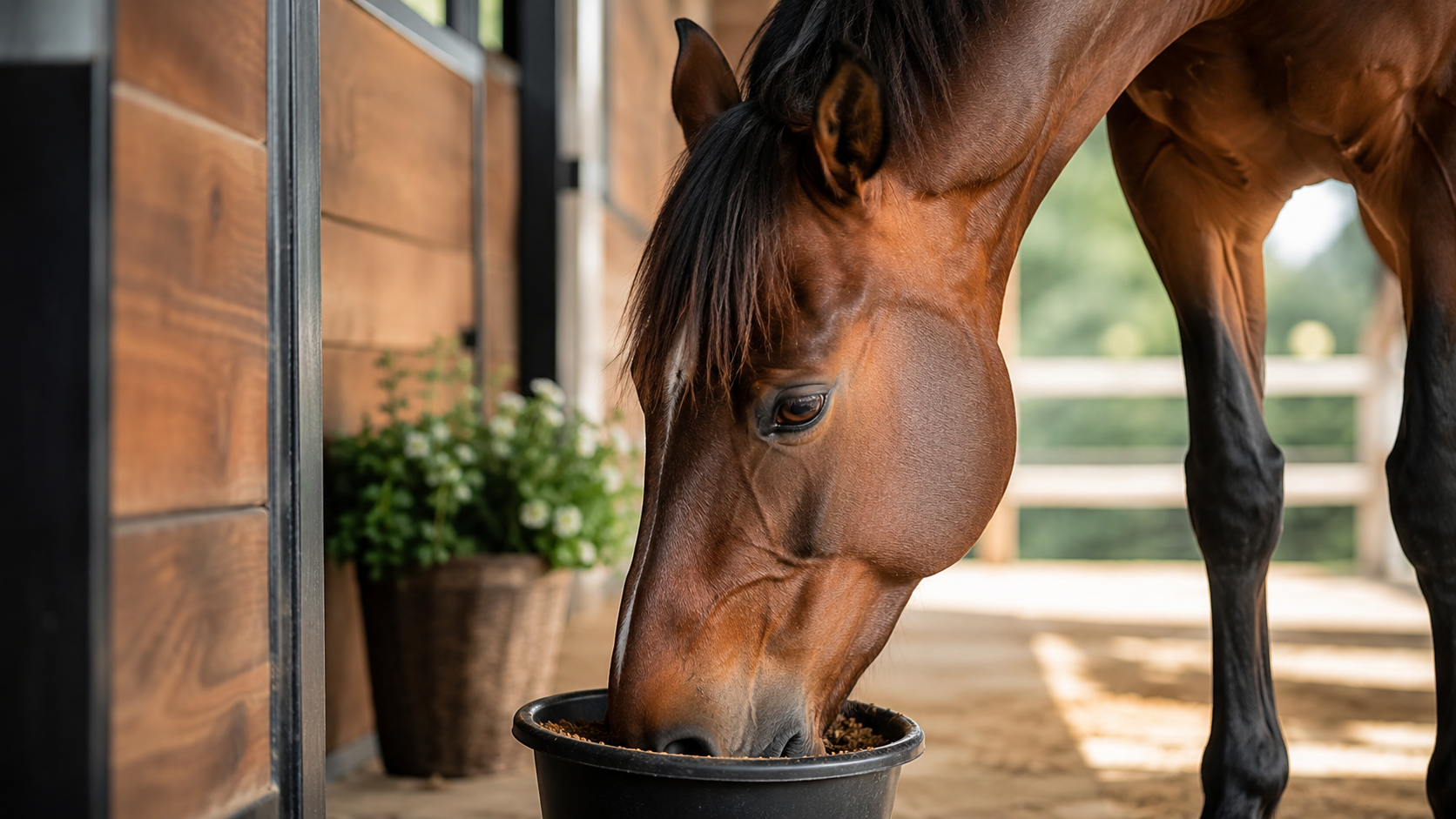
The Maremmano is a hardy and economical horse, accustomed to sometimes difficult living conditions. It has an efficient metabolism and can thrive on medium-quality forage. It is important to provide a balanced diet, primarily based on good quality hay ad libitum. Concentrates are only necessary for horses undergoing intense work and must be adapted to their activity level to prevent obesity.
As a hardy and economical breed, the Maremmano can be predisposed to obesity if overfed or lacking exercise, which can increase the risk of laminitis or Equine Metabolic Syndrome (EMS). It is therefore crucial to monitor its weight and adjust its diet accordingly. There is no documented predisposition to PSSM or other specific sugar/starch sensitivities for this breed.
With Equio, every feed, supplement or treat is read against the horse's real profile (age, weight, Body Condition Score, conditions) — useful for a Maremmano as soon as a metabolic or digestive sensitivity is known.
Health and points to watch
The Maremmano's robustness makes it a generally healthy horse. Its weight should be monitored, especially if it lives in a pasture with rich grass. Particular attention should be paid to hoof care, as even though they are naturally strong, this helps prevent foot ailments.
- More frequent conditions: Problems related to obesity (laminitis, EMS) in case of overfeeding, Osteoarthritis in older horses or those with an intense career
Care and grooming
The Maremmano is an easy-care horse. Its naturally hard hooves require regular trimming but can often go barefoot if working on suitable terrain. Its mane and tail are generally thick and require regular brushing. Its dense coat protects it well from the elements and does not require special care; clipping is generally not necessary except for intensive work in winter.
Did you know?
- The butteri, the cowboys of the Maremma, are famous for their skill in working cattle on horseback, and the Maremmano is their traditional and indispensable mount.
- In 1911, the butteri of the Maremma, mounted on their Maremmanos, challenged and defeated a team of American cowboys led by Buffalo Bill during a show in Rome, demonstrating the superiority of their horses and their cattle-working technique.
- The Maremmano is sometimes nicknamed the 'swamp horse' due to its adaptation to the wetlands of the Maremma.
The Maremmano and how to track it
The Maremmano breed is not widespread in France, where it is mainly appreciated by enthusiasts of hardy Italian breeds, trail riders, or breeders looking for versatile and robust horses. Breeding remains marginal.
Equio lets you build a complete profile for a Maremmano: identity, weight, Body Condition Score, feeding, conditions, care reminders (vaccines, worming, trimming) and an exportable health log. The breed sets the identity; everyday decisions still depend on the real horse and your vet's advice.
- Record the activity level: rest, leisure, sport or breeding
- Add known conditions or sensitivities
- Scan feeds, plants and care products
- Keep reminders (vaccines, worming, trimming)
- Prepare a PDF export before a vet appointment
Frequently asked questions
Is the Maremmano suitable for beginners?
Yes, thanks to its calm and willing temperament, the Maremmano can be an excellent mount for beginners or less experienced riders, provided it has been properly trained. Its robustness and reliability make it a safe companion.
What is the average price of a Maremmano?
The price of a Maremmano varies considerably depending on its age, training level, lineage, and potential. In Italy, prices can range from €3,000 to €8,000 or more for well-trained horses or those with good bloodlines. In France, the rarity of the breed can influence the price.
Can the Maremmano live in a pasture all year round?
Absolutely. The Maremmano is a hardy breed perfectly adapted to living outdoors all year round, provided it has natural or artificial shelter to protect itself from the elements and access to water and forage. Its robust constitution and dense coat effectively protect it from cold and humidity.
Is the Maremmano a good family horse?
Yes, its gentle, patient, and reliable temperament makes it an excellent family horse. It is generally very tolerant and can be ridden by different family members for various activities, from trail riding to light work.
What are the main qualities of the Maremmano?
The main qualities of the Maremmano are its robustness, endurance, courage, intelligence, and versatility. It is a reliable, resilient horse with excellent hooves, ideal for outdoor work and long trail rides.