
Horse breed
Pottok
The Basque Mountain Horse, or Pottok, is a very ancient breed, descending from the wild horses that populated the Pyrenees. Its origin is linked to Iberian and Celtic horses.

The breed at a glance
The Pottok is renowned for its calm, gentle, and willing temperament. It is intelligent, courageous, and very hardy, making it an excellent companion for work and leisure. It is also very people-oriented.
- Category
- hardy breed
- Origin
- France · Antiquity
- Height at withers
- 115–132 cm
- Weight
- 250–350 kg
- Lifespan
- 25-30 years
- Common coats
- black, bay, chestnut
- Disciplines
- equestrian trail riding, TREC, pony games, leisure driving
- Other names
- Pottok de Montagne, Pottoka de Montaña
Origin and history
The Basque Mountain Horse, or Pottok, is a very ancient breed, descending from the wild horses that populated the Pyrenees. Its origin is linked to Iberian and Celtic horses. The breed was shaped by its mountainous environment and extensive breeding. It was officially recognized in France in 1970, with the distinction between the Mountain Pottok and the Plains Pottok.

Conformation and physique
It is a small-sized pony, with a compact and stocky build, a solid bone structure, and well-developed musculature, adapted to mountain life. It presents a hardy and robust silhouette.
The head is expressive, medium-sized, with a straight or slightly concave profile. The eyes are lively and intelligent, the ears small and well-set. The face is broad.
The neck is short, thick, and well-muscled, blending harmoniously into a low but well-defined wither.
The back is short and strong, the topline is taut. The chest is broad and deep, indicative of good respiratory capacity. The croup is rounded and muscular, often double.
The limbs are short, clean, and very strong, with well-defined joints and correct conformation. The hooves are small, hard, and resilient. The feathers are sparse.
- Common coats: black, bay, chestnut
Temperament and aptitudes
The Pottok is renowned for its calm, gentle, and willing temperament. It is intelligent, courageous, and very hardy, making it an excellent companion for work and leisure. It is also very people-oriented.
Its gaits are short, energetic, and sure-footed, with great agility and exceptional mountain footing, allowing it to move with ease over difficult terrain.
- Uses: packing, light logging, recreational riding, driving, landscape maintenance, equine-assisted therapy, meat production (historically)
- Disciplines: equestrian trail riding, TREC, pony games, leisure driving
Feeding the Pottok
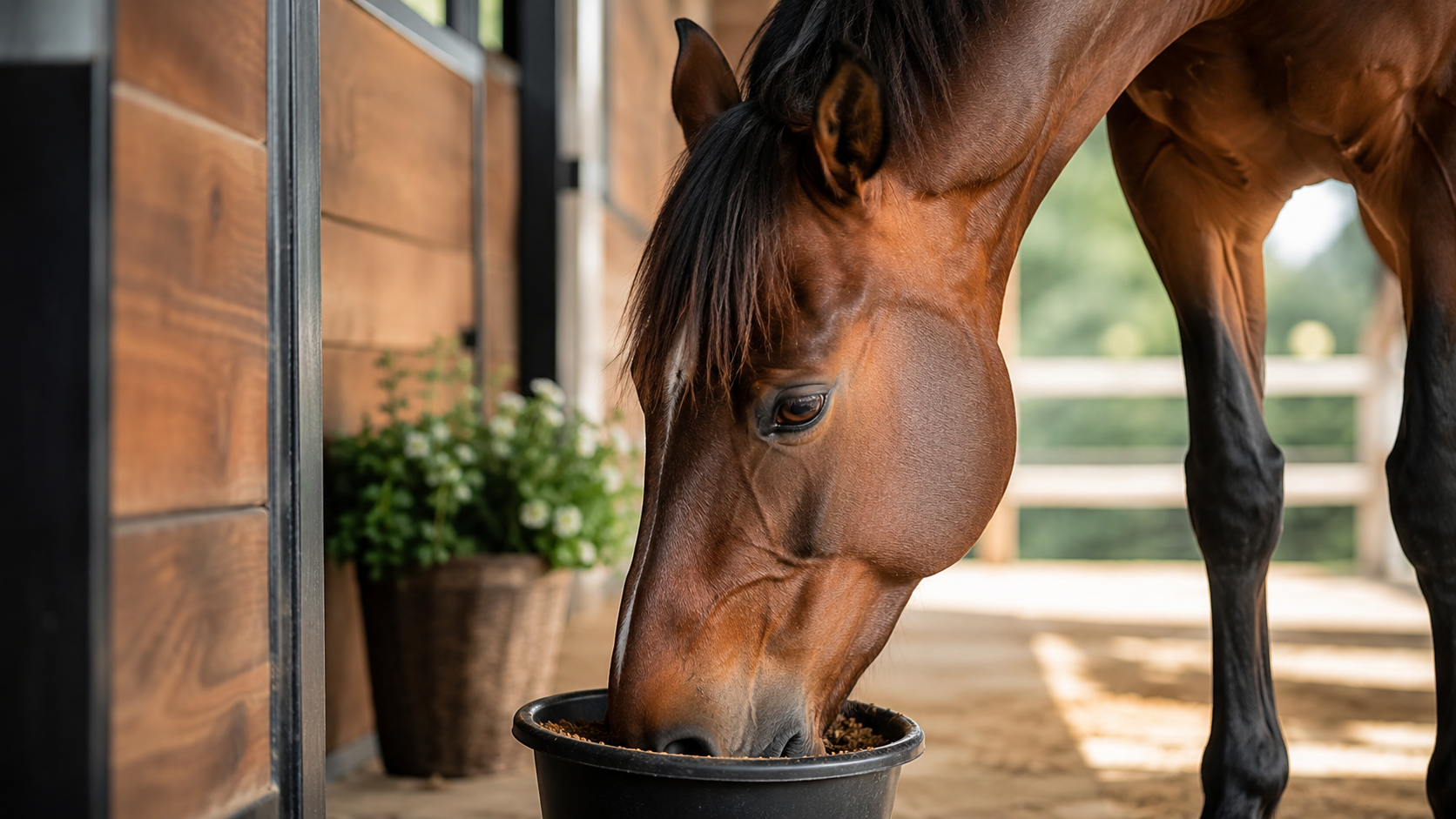
The Pottok is a very economical horse, accustomed to limited resources. Its metabolism is adapted to mountain life, making it able to utilize low-quality forage. It tends to gain weight if its diet is too rich. Concentrate intake is only necessary for intense work or harsh winter conditions.
Due to its thrifty metabolism, the Pottok can be predisposed to Equine Metabolic Syndrome (EMS) and laminitis if overfed or sedentary, especially with diets rich in sugars and starch. Careful dietary management is crucial to prevent these conditions.
With Equio, every feed, supplement or treat is read against the horse's real profile (age, weight, Body Condition Score, conditions) — useful for a Pottok as soon as a metabolic or digestive sensitivity is known.
Health and points to watch
It is important to monitor its weight and adjust its diet to avoid obesity and the risk of laminitis. Particular attention should be paid to the quality of its hooves, which, although naturally resilient, can suffer from problems related to moisture or excessive wear.
- More frequent conditions: laminitis, Equine Metabolic Syndrome (EMS)
Care and grooming
The Pottok is a hardy breed that requires little specific care. Its hard hooves need regular trimming but are very resilient. Its dense coat protects it well from the elements, and it is generally not necessary to clip it. Regular brushing is sufficient to maintain its coat.
Did you know?
- The name 'Pottok' means 'small horse' in Basque.
- There are two types of Pottok: the Mountain Pottok (more rustic) and the Plains Pottok (taller and more refined, often resulting from crossbreeding).
- The Pottok is often raised semi-feral in the Basque mountains, contributing to pasture maintenance.
The Pottok and how to track it
The Pottok is primarily bred in the French Basque Country, where it plays an important role in local culture and economy. Its population is stable and is subject to conservation programs.
Equio lets you build a complete profile for a Pottok: identity, weight, Body Condition Score, feeding, conditions, care reminders (vaccines, worming, trimming) and an exportable health log. The breed sets the identity; everyday decisions still depend on the real horse and your vet's advice.
- Record the activity level: rest, leisure, sport or breeding
- Add known conditions or sensitivities
- Scan feeds, plants and care products
- Keep reminders (vaccines, worming, trimming)
- Prepare a PDF export before a vet appointment
Frequently asked questions
Is the Pottok suitable for children?
Yes, thanks to its gentle, calm, and patient temperament, the Pottok is particularly suitable for children and beginners. Its small size and robustness make it an excellent learning pony and family leisure horse.
What is the price of a Pottok?
The price of a Pottok varies depending on its age, sex, lineage, training level, and coat color. Generally, a Pottok can cost between 1,000 and 3,000 euros, but well-trained individuals or those with good bloodlines can reach higher prices.
Can the Pottok live outdoors all year round?
Absolutely. The Pottok is a very hardy breed, perfectly adapted to outdoor life all year round, even in harsh climatic conditions. Its thick coat and natural robustness allow it to withstand cold and humidity, provided it has natural or artificial shelter.
What is the difference between a Mountain Pottok and a Plains Pottok?
The Mountain Pottok is the original type, smaller (1.15m to 1.32m), stockier, and more rustic, raised semi-feral. The Plains Pottok is generally taller (up to 1.47m), more refined, and often results from crossbreeding with other breeds to improve it for sport or leisure riding.
Is the Pottok an endangered breed?
Although its population experienced declines in the past, the Pottok is no longer considered an endangered breed. Conservation and promotion efforts for the breed have helped stabilize and increase its numbers, particularly through its use in leisure riding and landscape maintenance.