
Horse breed
Tuigpaard
The Tuigpaard is a relatively young breed, developed in the Netherlands from the beginning of the 20th century. It originated from selective crosses between Gelderland and Groningen type horses, with the addition of Hackney blood and other carriage horse breeds.

The breed at a glance
The Tuigpaard is an energetic, lively horse with a willing temperament. It is intelligent and responsive, but can sometimes be sensitive. It requires an experienced rider or driver capable of channeling its energy and working with it subtly.
- Category
- sport horse
- Origin
- Netherlands · 20th century
- Height at withers
- 158–170 cm
- Weight
- 500–650 kg
- Lifespan
- 20-25 years
- Common coats
- bay, chestnut, black, grey
- Disciplines
- sport driving (dressage, marathon, cones), show driving
- Other names
- Dutch Harness Horse
Origin and history
The Tuigpaard is a relatively young breed, developed in the Netherlands from the beginning of the 20th century. It originated from selective crosses between Gelderland and Groningen type horses, with the addition of Hackney blood and other carriage horse breeds. The objective was to create an elegant and high-performing carriage horse, endowed with elevated gaits and a lively temperament. The breed was officially recognized and its studbook established to preserve its unique characteristics.
Conformation and physique
The Tuigpaard is a medium to large-sized horse, elegant and athletic, with a strong yet refined bone structure. Its silhouette is characterized by an elevated topline and a proud head carriage, typical of high-performance carriage horses.
The head is expressive, medium-sized, with a straight or slightly convex profile. The eyes are large and lively, and the ears are well-placed and alert.
The neck is long, powerful, and very arched, set high on the withers, which contributes to its elevated and proud head carriage. The withers are well-defined and extended.
The back is short and strong, the topline is taut and muscular. The chest is deep and broad, providing ample room for the lungs. The croup is powerful, often slightly sloped, with a high-set tail.
The limbs are long, clean, and muscular, with large and well-defined joints. The cannons are strong, and the feet are well-formed, often with sparse feathering.
- Common coats: bay, chestnut, black, grey
Temperament and aptitudes
The Tuigpaard is an energetic, lively horse with a willing temperament. It is intelligent and responsive, but can sometimes be sensitive. It requires an experienced rider or driver capable of channeling its energy and working with it subtly.
The gaits are spectacular, characterized by high and elevated action of the knees and hocks, particularly at the trot. The Tuigpaard possesses a powerful, expansive, and very expressive trot, with great impulsion.
- Uses: competition driving, leisure driving, equestrian show, riding horse (to a lesser extent)
- Disciplines: sport driving (dressage, marathon, cones), show driving
Feeding the Tuigpaard
The Tuigpaard is an athlete that, during periods of intense work, has high energy requirements. It needs a balanced diet, rich in good quality forage (hay or grass) in sufficient quantities. Depending on the intensity of work, concentrates (grains, compound feeds) may be necessary to meet its energy and protein needs. It is important to monitor its body condition to avoid being overweight or underweight.
Although there are no documented genetic predispositions to specific metabolic disorders like PSSM or EMS, like any sport horse, the Tuigpaard can be sensitive to dietary imbalances. A diet too rich in sugars and starch, without sufficient exercise, can increase the risk of laminitis or digestive issues. Careful dietary management is crucial.
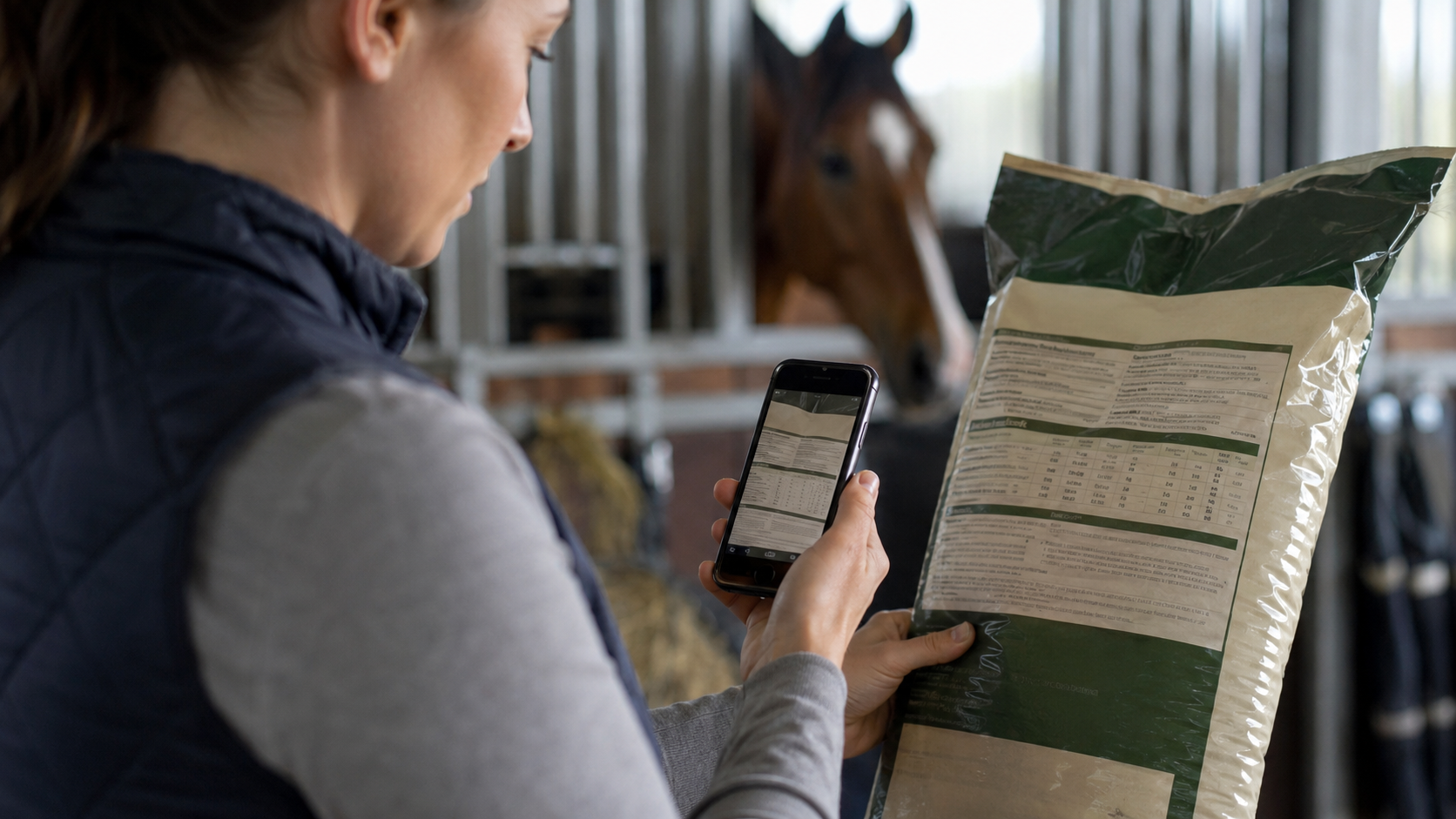
With Equio, every feed, supplement or treat is read against the horse's real profile (age, weight, Body Condition Score, conditions) — useful for a Tuigpaard as soon as a metabolic or digestive sensitivity is known.

Health and points to watch
Particular attention must be paid to the locomotor system due to the elevated action and intensity of work in driving. Regular veterinary examinations, appropriate trimming, and shoeing are essential. Stress management and a stable environment are also important for its general well-being.
- More frequent conditions: locomotor affections related to work intensity (tendinitis, osteoarthritis), dental problems (as with all horses)
Care and grooming
The care of a Tuigpaard is similar to that of a sport horse. Hooves require regular trimming or shoeing adapted to its driving work to support its gaits. The mane and tail are often left long and maintained for presentation. The coat is brushed daily to maintain its shine. Clipping may be necessary in winter if the horse is working intensely.
Did you know?
- The Tuigpaard is often judged on its 'zweefmoment' (moment of suspension) at the trot, where it appears to float above the ground.
- Tuigpaard driving competitions in the Netherlands are true spectacles, where the elegance of the horses and turnouts is paramount.
- The name 'Tuigpaard' literally means 'carriage horse' in Dutch.
The Tuigpaard and how to track it
The Tuigpaard breed is not widely represented in France, where breeding is marginal. A few individuals are imported for competition or leisure driving by enthusiasts of the breed.
Equio lets you build a complete profile for a Tuigpaard: identity, weight, Body Condition Score, feeding, conditions, care reminders (vaccines, worming, trimming) and an exportable health log. The breed sets the identity; everyday decisions still depend on the real horse and your vet's advice.
- Record the activity level: rest, leisure, sport or breeding
- Add known conditions or sensitivities
- Scan feeds, plants and care products
- Keep reminders (vaccines, worming, trimming)
- Prepare a PDF export before a vet appointment
Frequently asked questions
Is the Tuigpaard a good horse for a beginner?
Due to its energy and lively temperament, the Tuigpaard is generally not recommended for beginners. It requires an experienced driver or rider, capable of understanding it and working with it with patience and firmness.
What is the cost of a Tuigpaard?
The price of a Tuigpaard varies considerably depending on its age, training level, bloodlines, and performance. A young, unbroken horse may cost a few thousand euros, while a proven competition horse can fetch much higher sums.
Can the Tuigpaard be ridden?
Although primarily bred for driving, some Tuigpaards can be ridden. However, their conformation and gaits are optimized for driving, and they may not be as comfortable or suitable for all ridden disciplines as other saddle breeds.
How can one recognize a purebred Tuigpaard?
A purebred Tuigpaard is registered in the Dutch studbook (KWPN Tuigpaard). It exhibits the typical morphological characteristics and gaits of the breed, including a high head carriage, an arched neck, and an elevated, powerful trot.
Is the Tuigpaard a rare breed?
The Tuigpaard is not considered a rare breed in the Netherlands, where it is well-established. However, outside its country of origin, its population is more limited, making it less common in other countries.