
Horse breed
Australian Pony
The Australian Pony originated from crosses between ponies imported to Australia in the 19th century, notably Timor Ponies, Exmoor Ponies, Shetland Ponies, and Welsh Ponies. The goal was to create a versatile, robust pony adapted to the Australian climate.
The breed at a glance
The Australian Pony is renowned for its calm, intelligent, and willing temperament. It is courageous, easy to train, and very versatile, making it an excellent companion for children and adults. It is also known for its kindness and reliability.
- Category
- pony
- Origin
- Australia · Late 19th century - Early 20th century
- Height at withers
- 112–142 cm
- Lifespan
- 25-30 years
- Common coats
- bay, chestnut, grey, black, palomino, dun
- Disciplines
- show jumping, dressage, eventing, pony games
- Other names
- Australian Pony
Origin and history
The Australian Pony originated from crosses between ponies imported to Australia in the 19th century, notably Timor Ponies, Exmoor Ponies, Shetland Ponies, and Welsh Ponies. The goal was to create a versatile, robust pony adapted to the Australian climate. The breed was officially recognized in 1931 with the creation of the Australian Pony Stud Book Society.

Conformation and physique
It is an elegant and well-proportioned pony, compact in build but with solid bone structure. It presents an athletic and harmonious silhouette, typical of riding ponies.
The head is refined, well-proportioned to the body, with a broad forehead, large expressive eyes, and a straight or slightly concave profile. The nostrils are open and the ears are well-placed, of medium size.
The neck is long, well-arched, and elegantly set, blending harmoniously into a well-defined and muscular wither.
The back is short and strong, the topline is taut. The chest is deep and broad, ensuring good lung capacity. The croup is long, muscular, and slightly sloped.
The limbs are strong, with clean and well-defined joints. The cannons are short and the hooves are hard and well-formed. Feathering is generally sparse.
- Common coats: bay, chestnut, grey, black, palomino, dun
Temperament and aptitudes
The Australian Pony is renowned for its calm, intelligent, and willing temperament. It is courageous, easy to train, and very versatile, making it an excellent companion for children and adults. It is also known for its kindness and reliability.
The gaits are supple, regular, and energetic, with good amplitude. The walk is active, the trot is airy, and the canter is balanced and comfortable.
- Uses: recreational riding, children's riding, driving, farm work (historical)
- Disciplines: show jumping, dressage, eventing, pony games, endurance riding, hunter, driving
Feeding the Australian Pony
The Australian Pony generally has an economical metabolism, capable of efficiently utilizing forage. It tends to gain weight if overfed or sedentary. A diet based on good quality forage (hay or grass) is paramount. Concentrates are only necessary in cases of intense work or specific needs (growth, gestation/lactation), and must be adapted to avoid excess sugars and starch.
Like many ponies with an economical metabolism, the Australian Pony can be predisposed to Equine Metabolic Syndrome (EMS) and laminitis, especially in cases of overweight or unlimited access to rich grass. Careful dietary management is crucial to prevent these conditions.
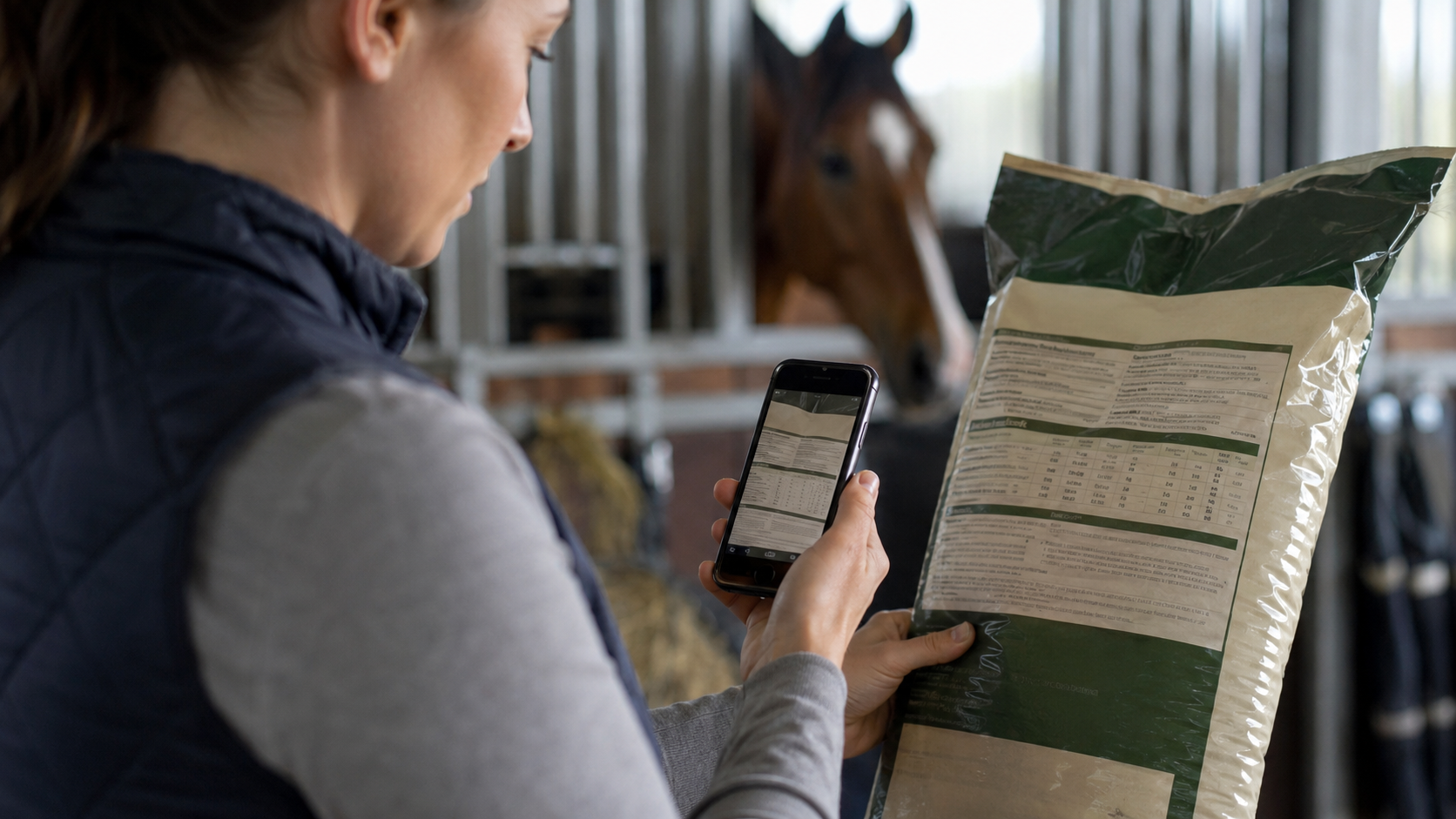
With Equio, every feed, supplement or treat is read against the horse's real profile (age, weight, Body Condition Score, conditions) — useful for a Australian Pony as soon as a metabolic or digestive sensitivity is known.

Health and points to watch
It is important to monitor the Australian Pony's weight and adapt its diet and exercise to prevent obesity and the risk of laminitis. Particular attention should be paid to hoof quality and regular maintenance.
- More frequent conditions: laminitis, Equine Metabolic Syndrome (EMS)
Care and grooming
The Australian Pony's hooves are generally strong and require regular trimming every 6 to 8 weeks. The mane and tail are often full and can be maintained by brushing. The coat is easy to care for; regular brushing is sufficient. Clipping may be considered for ponies working intensely in winter.
Did you know?
- The Australian Pony is often nicknamed the 'family pony' in Australia due to its versatility and good temperament.
- It is highly valued in 'show riding' competitions in Australia for its elegance and gaits.
- The breed was developed to be able to withstand Australia's sometimes harsh climatic conditions.
The Australian Pony and how to track it
The Australian Pony breed is not widespread in France, where it is mainly found with a few passionate breeders or imported for leisure riding and children's competitions.
Equio lets you build a complete profile for a Australian Pony: identity, weight, Body Condition Score, feeding, conditions, care reminders (vaccines, worming, trimming) and an exportable health log. The breed sets the identity; everyday decisions still depend on the real horse and your vet's advice.
- Record the activity level: rest, leisure, sport or breeding
- Add known conditions or sensitivities
- Scan feeds, plants and care products
- Keep reminders (vaccines, worming, trimming)
- Prepare a PDF export before a vet appointment
Frequently asked questions
Is the Australian Pony suitable for beginners?
Yes, the Australian Pony is renowned for its calm temperament, kindness, and reliability, making it an excellent choice for beginner riders, especially children. Its docility facilitates learning.
What is the maximum height of an Australian Pony?
The maximum permitted height for an Australian Pony is 142 cm at the withers. This places it in the medium-sized pony category, suitable for a wide range of riders.
Is the Australian Pony a good sport pony?
Absolutely. Thanks to its smooth gaits, agility, and willing temperament, the Australian Pony excels in many sporting disciplines such as show jumping, dressage, eventing, and pony games.
How to prevent laminitis in an Australian Pony?
To prevent laminitis, it is essential to carefully manage the diet, limiting sugar and starch intake, and prioritizing quality forage. Regular exercise and weight monitoring are also crucial, especially on rich pastures.
Where can Australian Ponies be found in France?
Australian Ponies are rare in France. They can be found through specialized breeders or via imports. It is advisable to contact breed associations or breeder networks for information.