
Horse breed
Knabstrupper
The Knabstrupper breed originated from a Spanish leopard mare named 'Flaebehoppen', acquired in 1812 by Major Villars Lunn and bred at the Knabstrup estate. Crossed with a Frederiksborg stallion, she gave birth to the founding lineage.
The breed at a glance
The Knabstrupper is renowned for its calm, gentle, and cooperative temperament. It is intelligent, willing, and easy to train, making it an excellent partner for various disciplines. Its kindness also makes it suitable for riders of all levels.
- Category
- saddle horse
- Origin
- Denmark · Early 19th century
- Height at withers
- 155–165 cm
- Weight
- 450–600 kg
- Lifespan
- 25-30 years
- Common coats
- leopard (dark spots on a white background), few spot (white with a few dark spots on the flanks), blanket (white blanket over the croup with or without spots), snowflake (white spots on a dark background), solid (solid coat, without spots, but carrying the leopard gene)
- Disciplines
- dressage, show jumping, driving, vaulting
- Other names
- Knabstrup
Origin and history
The Knabstrupper breed originated from a Spanish leopard mare named 'Flaebehoppen', acquired in 1812 by Major Villars Lunn and bred at the Knabstrup estate. Crossed with a Frederiksborg stallion, she gave birth to the founding lineage. The breed was developed for its versatile abilities and distinctive spotted coat. It experienced a decline in the early 20th century before being revived by the introduction of Appaloosa blood. The modern studbook was established in 1971.
Conformation and physique
The Knabstrupper is a medium to large-sized saddle horse, well-proportioned and harmonious. It has a solid bone structure without being heavy, with well-developed musculature. Its silhouette is elegant and athletic.
The head is expressive, medium-sized, with a straight or slightly convex profile. The eyes are lively and intelligent, sometimes with a visible sclera (white of the eye). The ears are medium-sized and well-placed.
The neck is well-set, long, and muscular, tapering towards the head. It is carried elegantly. The withers are well-defined and extended.
The back is short and strong, and the topline is harmonious. The chest is broad and deep, ensuring good respiratory capacity. The croup is muscular and slightly sloped.
The limbs are strong, with large and well-defined joints. The cannons are short and the tendons are clean. The hooves are round and hard, often striped. Feathering is generally sparse.
- Common coats: leopard (dark spots on a white background), few spot (white with a few dark spots on the flanks), blanket (white blanket over the croup with or without spots), snowflake (white spots on a dark background), solid (solid coat, without spots, but carrying the leopard gene)
Temperament and aptitudes
The Knabstrupper is renowned for its calm, gentle, and cooperative temperament. It is intelligent, willing, and easy to train, making it an excellent partner for various disciplines. Its kindness also makes it suitable for riders of all levels.
The gaits are ample, supple, and energetic, with good hindquarter engagement. The walk is regular, the trot is elevated, and the canter is balanced and rhythmic, showing good impulsion.
- Uses: versatile riding horse, driving, circus, recreational riding, dressage, show jumping
- Disciplines: dressage, show jumping, driving, vaulting, working equitation
Feeding the Knabstrupper
The Knabstrupper is generally a horse with a rather efficient metabolism, capable of effectively utilizing its feed. It tends to gain weight if not worked sufficiently or if its diet is too rich. A diet based on good quality forage in sufficient quantity is paramount. Concentrates should be adjusted sparingly according to the intensity of work to avoid excesses.
Like many horses with an efficient metabolism, the Knabstrupper can be predisposed to Equine Metabolic Syndrome (EMS) and laminitis if overfed or if it has unlimited access to rich pastures. Careful monitoring of its weight and rigorous dietary management are essential to prevent these conditions.
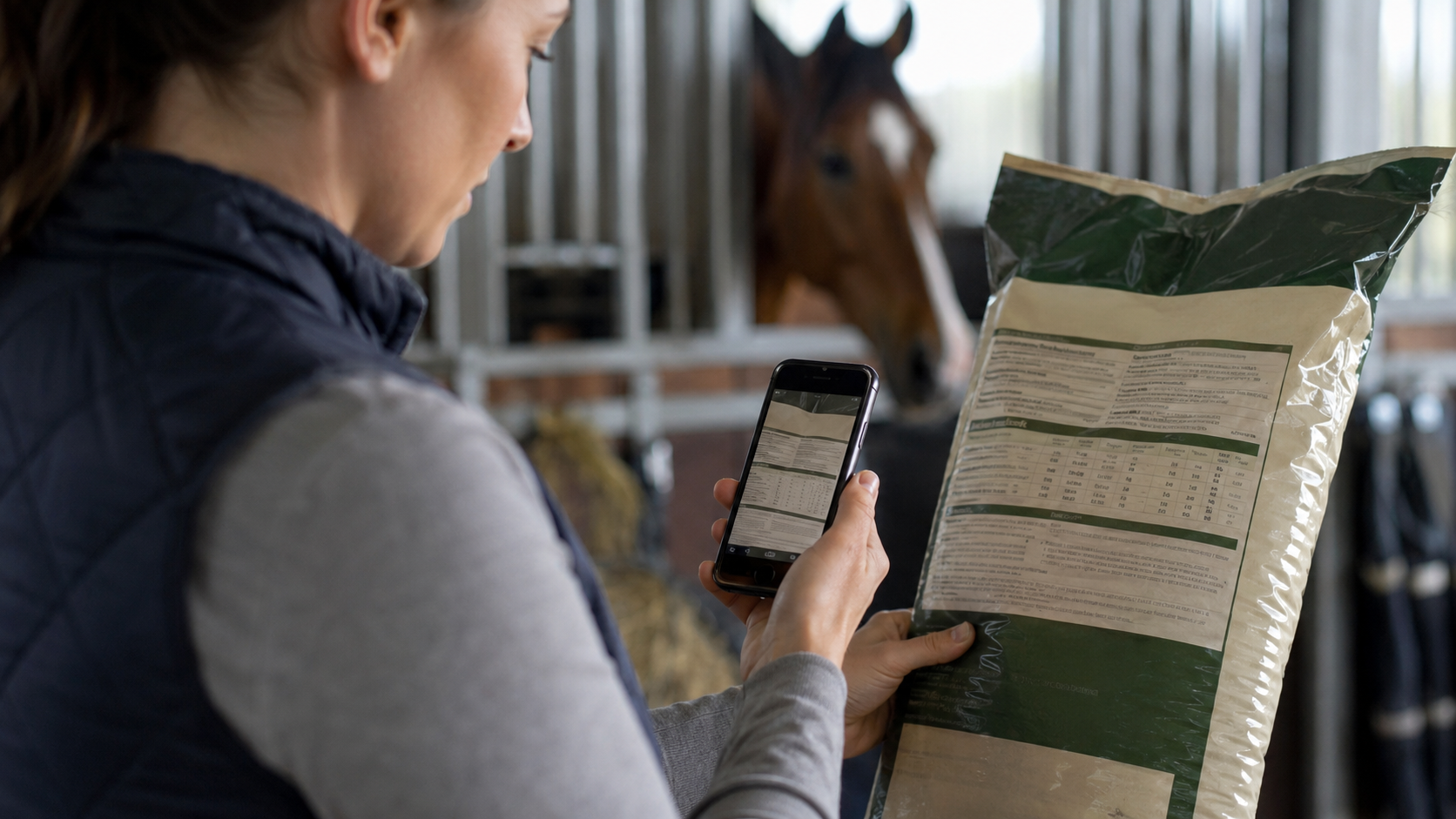
With Equio, every feed, supplement or treat is read against the horse's real profile (age, weight, Body Condition Score, conditions) — useful for a Knabstrupper as soon as a metabolic or digestive sensitivity is known.

Health and points to watch
Particular attention should be paid to the eyes due to the predisposition to recurrent uveitis, especially in individuals with a very visible sclera. Weight management is crucial to prevent metabolic risks. Regular dental and farrier care is also important.
- Documented genetic disorders: Congenital Stationary Night Blindness (CSNB)
- More frequent conditions: Equine Recurrent Uveitis (ERU)
Care and grooming
Knabstrupper care is typical for a saddle horse. The hooves, often of good quality, require regular trimming. The mane and tail can be thick and require regular detangling. The coat, regardless of color, is easy to maintain. Eye monitoring is recommended due to the predisposition to uveitis.
Did you know?
- The Knabstrupper's leopard coat is due to a genetic complex called the 'Leopard gene' (LP), which is also responsible for Congenital Stationary Night Blindness (CSNB) in the homozygous state.
- Knabstruppers are often used in circuses and equestrian shows due to their spectacular coat and cooperative temperament.
- The Knabstrupper is one of the few equine breeds to have a visible sclera (white of the eye), a trait often associated with spotted coats.
The Knabstrupper and how to track it
The Knabstrupper breed is present in France, although its population remains modest. A few passionate breeders contribute to its development, and it is mainly found in leisure riding, dressage, and driving.
Equio lets you build a complete profile for a Knabstrupper: identity, weight, Body Condition Score, feeding, conditions, care reminders (vaccines, worming, trimming) and an exportable health log. The breed sets the identity; everyday decisions still depend on the real horse and your vet's advice.
- Record the activity level: rest, leisure, sport or breeding
- Add known conditions or sensitivities
- Scan feeds, plants and care products
- Keep reminders (vaccines, worming, trimming)
- Prepare a PDF export before a vet appointment
Frequently asked questions
What is the average price of a Knabstrupper?
The price of a Knabstrupper varies considerably depending on its age, training level, lineage, and coat pattern. It can range from €5,000 for an unbroken young horse to over €15,000 for a trained horse with good athletic abilities.
Is the Knabstrupper suitable for beginners?
Yes, thanks to its calm, gentle, and cooperative temperament, the Knabstrupper is often considered an excellent breed for beginner riders or children. Its patience and willingness to please make it a safe partner.
Is the Knabstrupper a good sport horse?
Absolutely. The Knabstrupper possesses good gaits, solid bone structure, and a willing temperament that makes it suitable for many equestrian disciplines, including dressage, show jumping, and driving. It is increasingly valued in these fields.
How do you care for the Knabstrupper's spotted coat?
Caring for a spotted coat is similar to caring for any horse's coat. Regular brushing is sufficient to maintain cleanliness and shine. The spots do not require specific care, but particular attention to lighter areas can be helpful to prevent stubborn dirt stains.
Is the Knabstrupper cold-hardy?
Yes, the Knabstrupper is a robust and hardy breed that tolerates temperate climates well. With adequate shelter and sufficient feed, it can live outdoors year-round, even in cold weather, thanks to its dense winter coat.