
Horse breed
Tuva Horse
The Tuva Horse is an ancient breed originating from the Tuva Republic in Southern Siberia. It is the result of natural selection and adaptation to a harsh environment, without major crossbreeding with foreign breeds.

The breed at a glance
The Tuva Horse is renowned for its calm, docile, and courageous temperament. It is very hardy, enduring, and frugal, making it an excellent work and trail horse, capable of withstanding extreme conditions.
- Category
- hardy breed
- Origin
- Russia (Tuva Republic) · Antiquity / Middle Ages
- Height at withers
- 130–145 cm
- Weight
- 300–400 kg
- Lifespan
- 25-30 years
- Common coats
- bay, chestnut, black, grey, dun, grullo
- Disciplines
- equestrian trail riding, endurance (leisure), working equitation
- Other names
- Tuva Horse, Tuvinian Horse
Origin and history
The Tuva Horse is an ancient breed originating from the Tuva Republic in Southern Siberia. It is the result of natural selection and adaptation to a harsh environment, without major crossbreeding with foreign breeds. Historically, it played a central role in the life of Tuvan nomads for transport, warfare, and the production of milk and meat. The breed is officially recognized in Russia.

Conformation and physique
It is a small-sized horse, compact and robust, with strong bone structure and well-developed musculature, typical of hardy breeds adapted to cold climates and difficult terrain.
Medium-sized head, often a bit coarse, with a straight or slightly convex profile. The eyes are expressive and the ears are medium-sized.
Short, thick, and muscular neck, well-set. The withers are low, blending into the topline.
Short and broad back, straight and strong topline. Deep and wide chest, well-sprung ribs. Short, broad, and muscular croup, often slightly sloped.
Short, strong, and clean limbs, with well-developed joints and clearly defined tendons. The hooves are hard and resilient. Moderate feathering is present, especially in winter.
- Common coats: bay, chestnut, black, grey, dun, grullo
Temperament and aptitudes
The Tuva Horse is renowned for its calm, docile, and courageous temperament. It is very hardy, enduring, and frugal, making it an excellent work and trail horse, capable of withstanding extreme conditions.
The gaits are energetic, sure-footed, and enduring, suitable for long journeys over varied terrain. The walk is active, the trot is supple, and the canter is powerful.
- Uses: transport (pack and harness), leisure and trail riding, breeding for meat and milk (koumiss), hunting, cattle work
- Disciplines: equestrian trail riding, endurance (leisure), working equitation
Feeding the Tuva Horse
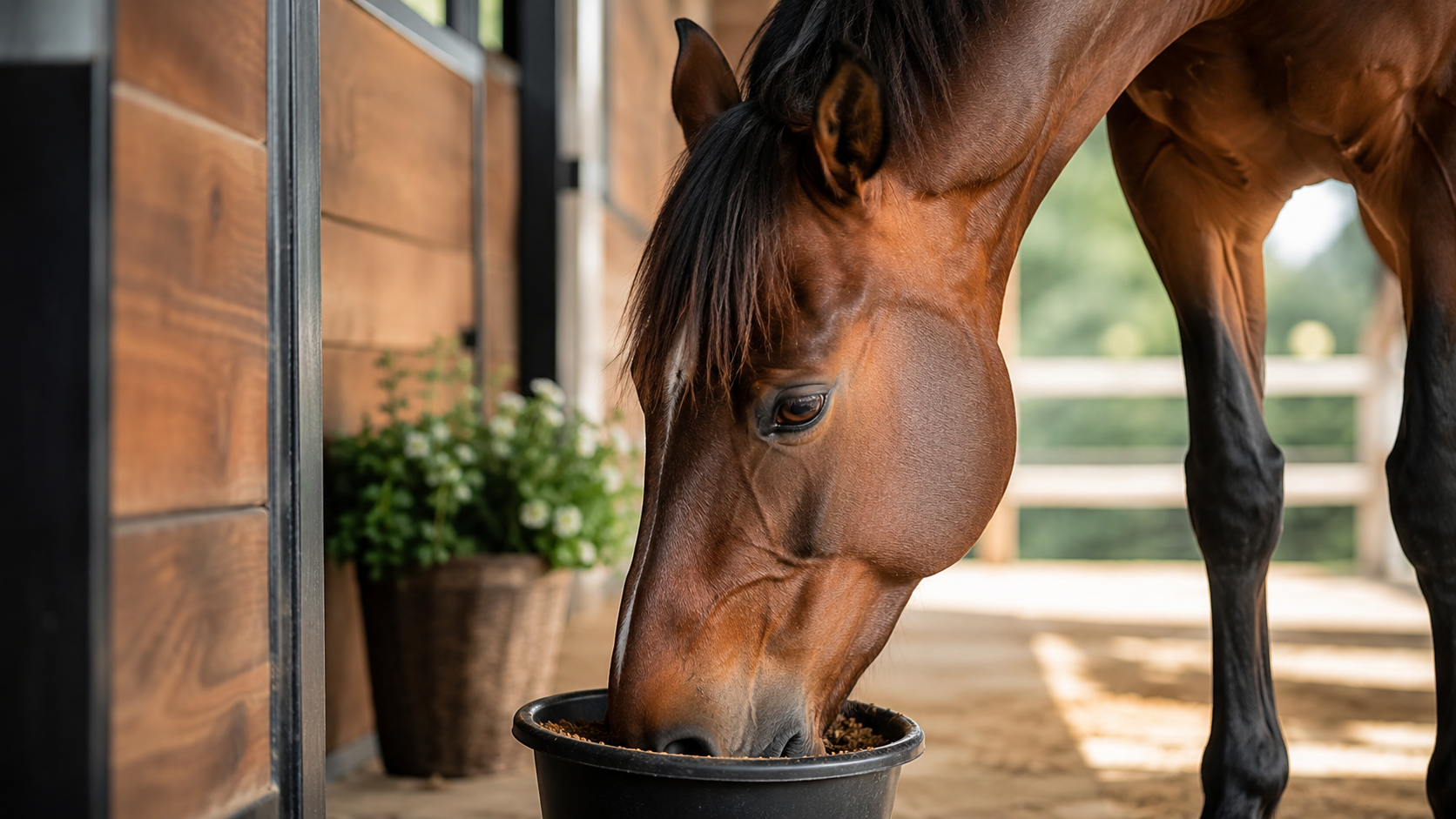
The Tuva Horse is a very economical breed, adapted to limited food resources. Its metabolism is designed to make the most of poor quality forage, and it has a strong tendency to gain weight if its diet is too rich. It generally thrives on good quality forage (grass, hay) and only requires concentrates during intense work or extreme winter conditions.
Due to its economical metabolism, the Tuva Horse can be predisposed to Equine Metabolic Syndrome (EMS) and laminitis if overfed or if it has unlimited access to rich pastures, especially in spring. Careful dietary management is crucial to prevent these conditions.
With Equio, every feed, supplement or treat is read against the horse's real profile (age, weight, Body Condition Score, conditions) — useful for a Tuva Horse as soon as a metabolic or digestive sensitivity is known.
Health and points to watch
Regular monitoring of weight and body condition is essential to prevent obesity and associated risks. The hooves, although robust, require regular trimming to maintain their integrity, especially if they are not naturally worn down on varied terrain.
- More frequent conditions: laminitis, Equine Metabolic Syndrome (EMS), age-related dental problems
Care and grooming
The Tuva Horse's hooves are naturally hard and resilient, requiring regular but often less frequent trimming than other breeds. Its mane and tail are thick and long, requiring occasional detangling. Its dense coat protects it well from the cold and does not require clipping, except for aesthetic reasons or intense work. Particular attention should be paid to the skin under the feathers in case of prolonged dampness.
Did you know?
- Tuvans traditionally use the Tuva Horse for the production of koumiss, a fermented drink made from mare's milk.
- This breed is capable of surviving extreme temperatures, ranging from -40°C in winter to +30°C in summer, thanks to its unique physiological adaptation.
- The Tuva Horse is renowned for its ability to find food under the snow in winter, an essential skill for its survival in its native environment.
The Tuva Horse and how to track it
The Tuva Horse is a very rare breed in France, if not non-existent in structured breeding programs. Its presence is likely limited to a few individuals imported by enthusiasts of hardy breeds or adventure riding.
Equio lets you build a complete profile for a Tuva Horse: identity, weight, Body Condition Score, feeding, conditions, care reminders (vaccines, worming, trimming) and an exportable health log. The breed sets the identity; everyday decisions still depend on the real horse and your vet's advice.
- Record the activity level: rest, leisure, sport or breeding
- Add known conditions or sensitivities
- Scan feeds, plants and care products
- Keep reminders (vaccines, worming, trimming)
- Prepare a PDF export before a vet appointment
Frequently asked questions
Is the Tuva Horse suitable for beginners?
Yes, thanks to its calm and docile temperament, the Tuva Horse can be an excellent companion for beginners, provided its training has been thorough. Its small size and hardiness also make it a reassuring horse.
What is the cost of a Tuva Horse?
The cost of a Tuva Horse is difficult to estimate in France due to its rarity. It would likely be high due to import costs and the difficulty in finding breeders. In its country of origin, its price is more modest.
Can the Tuva Horse live outdoors all year round?
Absolutely. The Tuva Horse is perfectly adapted to living outdoors all year round, even in cold climates, thanks to its dense coat and hardiness. However, it will appreciate a shelter to protect itself from wind and extreme weather.
What is the difference between the Tuva Horse and the Mongolian Horse?
Although geographically and morphologically similar, the Tuva Horse is generally a little larger and heavier than the Mongolian Horse. Both breeds share great hardiness and an adaptation to nomadic living conditions, but the Tuva evolved in a more mountainous and forested environment.
Is the Tuva Horse good for endurance?
Yes, the Tuva Horse is naturally very enduring. It is capable of covering long distances over difficult terrain without tiring, making it an excellent partner for equestrian trekking and recreational endurance riding. However, it is not bred for the speed required in modern endurance competitions.