
Horse breed
Mongolian Horse
The Mongolian Horse is an ancient breed, directly descended from wild horses of Central Asia. It played a crucial role in the history of Mongolia, particularly during the conquests of Genghis Khan.

The breed at a glance
The Mongolian Horse is renowned for its hardy, courageous, and resilient temperament. It is intelligent, self-sufficient, and possesses a strong survival instinct. Although sometimes independent, it is generally docile and loyal to its rider, but can be stubborn.
- Category
- hardy breed
- Origin
- Mongolia · Antiquity (several millennia)
- Height at withers
- 125–145 cm
- Weight
- 250–350 kg
- Lifespan
- 25-30 years
- Common coats
- bay, chestnut, black, grey, dun, grullo, mouse gray, palomino, cream
- Disciplines
- endurance riding, equestrian trail riding, traditional races
- Other names
- Mongolian Horse, Mongol Mor'
Origin and history
The Mongolian Horse is an ancient breed, directly descended from wild horses of Central Asia. It played a crucial role in the history of Mongolia, particularly during the conquests of Genghis Khan. Its selection occurred naturally through survival in extreme conditions, without significant human intervention for crossbreeding. The breed does not have an official studbook in the Western sense but is recognized for its genetic purity and adaptation to its environment.

Conformation and physique
It is a small, compact, and robust horse, with strong bone structure and dense musculature. Its silhouette is typical of hardy breeds, adapted to survival in hostile environments.
The head is relatively large in proportion to the body, with a straight or slightly convex profile. The eyes are small and expressive, the ears short and well-set.
The neck is short, thick, and muscular, well-set into the body. The withers are not very pronounced, blending into the topline.
The back is short and strong, the topline is straight and solid. The chest is broad and deep, offering great lung capacity. The croup is short, broad, and muscular, often slightly sloped.
The limbs are short, clean, and very strong, with well-developed joints and well-defined tendons. The hooves are small, round, and extremely hard, adapted to rocky terrain. Feathering is sparse.
- Common coats: bay, chestnut, black, grey, dun, grullo, mouse gray, palomino, cream
Temperament and aptitudes
The Mongolian Horse is renowned for its hardy, courageous, and resilient temperament. It is intelligent, self-sufficient, and possesses a strong survival instinct. Although sometimes independent, it is generally docile and loyal to its rider, but can be stubborn.
Their gaits are energetic and enduring, with a sure-footed walk and a steady trot. The canter is powerful and sustained, allowing them to cover long distances. Some Mongolian horses may exhibit additional gaits such as the pace.
- Uses: working mount (herding, transport), traditional horse racing, milk (mare) and meat production, source of hair for crafts, leisure and endurance riding
- Disciplines: endurance riding, equestrian trail riding, traditional races
Feeding the Mongolian Horse
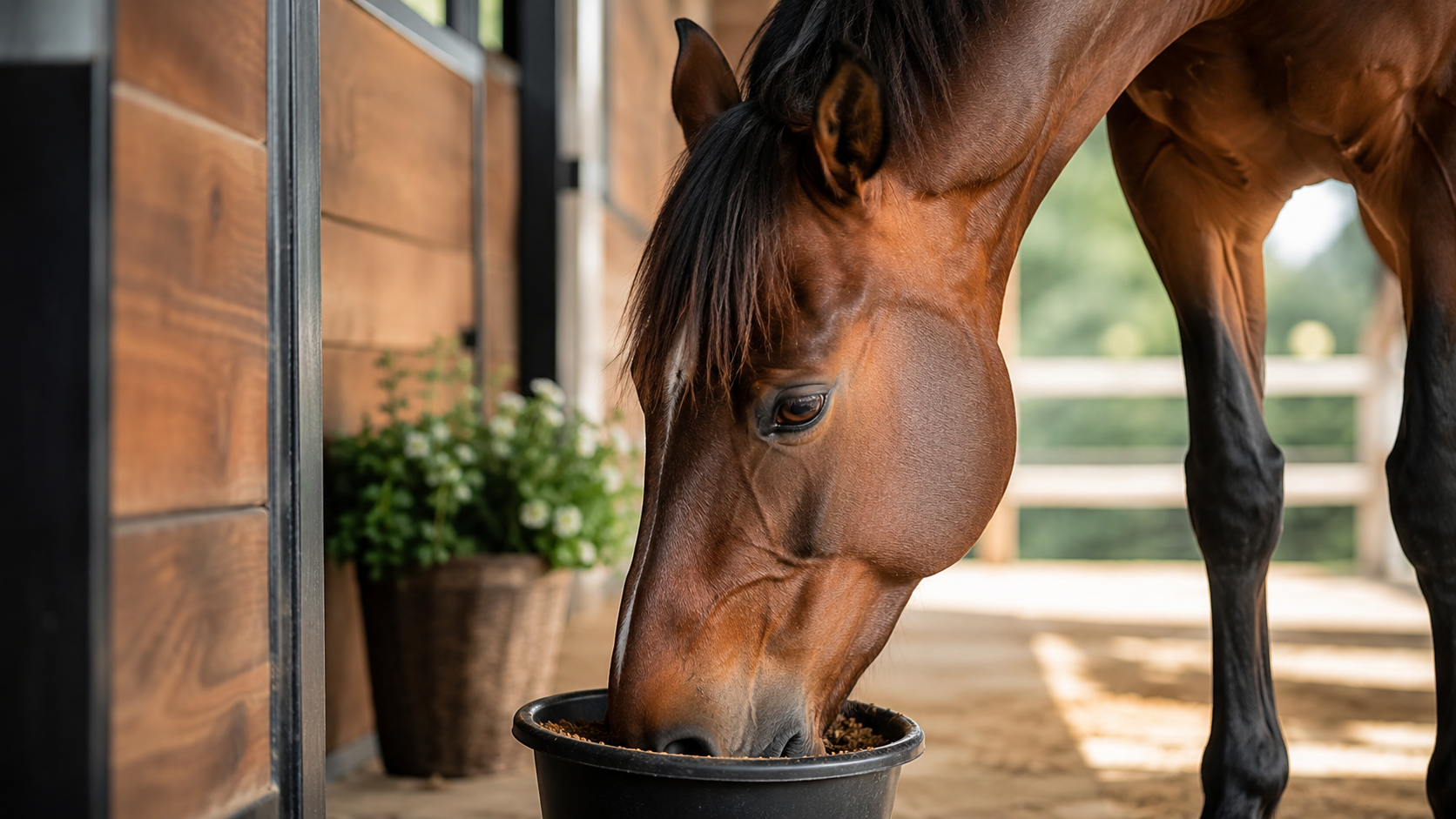
The Mongolian Horse is an extremely efficient metabolizer, adapted to sparse diets and periods of scarcity. It utilizes coarse forages very well and has low energy requirements. It is capable of finding food even under snow. Concentrates are rarely necessary, except in cases of very intense work or extreme winter conditions.
Due to its efficient metabolism, the Mongolian Horse is potentially susceptible to obesity and metabolic disorders (such as Equine Metabolic Syndrome or laminitis) if fed a diet too rich in sugars and starch, or if kept in Western husbandry conditions with unlimited access to rich pasture. Careful dietary management is crucial to prevent these issues.
With Equio, every feed, supplement or treat is read against the horse's real profile (age, weight, Body Condition Score, conditions) — useful for a Mongolian Horse as soon as a metabolic or digestive sensitivity is known.
Health and points to watch
Body condition monitoring is essential to prevent obesity. Particular attention must be paid to parasite management, especially if the horse lives in a herd. Hooves, although very hard, require regular trimming if the horse is not on abrasive terrain.
- More frequent conditions: gastrointestinal parasitism (in natural environments), dental problems related to tooth wear from hard forages
Care and grooming
Care is generally simple. Hooves, exceptionally hard, require regular trimming if the horse does not naturally wear down its feet. The mane and tail are very full and may require occasional detangling. The thick coat provides good protection from the cold and does not require clipping, except for aesthetic reasons or intense work. The skin is robust and not prone to ailments.
Did you know?
- The Mongolian Horse can survive temperatures ranging from -40°C in winter to +30°C in summer, thanks to its thick coat and its ability to store reserves.
- Mongolian mares are traditionally milked for their milk, which is then fermented to produce airag (koumis), a national alcoholic beverage.
- Mongolian horse races, part of the Naadam festival, are endurance events over very long distances (up to 30 km), ridden by young children.
The Mongolian Horse and how to track it
The Mongolian Horse is very rare in France. There are no significant breeding operations or a French studbook. A few individuals may be found with private owners passionate about hardy breeds or endurance riding.
Equio lets you build a complete profile for a Mongolian Horse: identity, weight, Body Condition Score, feeding, conditions, care reminders (vaccines, worming, trimming) and an exportable health log. The breed sets the identity; everyday decisions still depend on the real horse and your vet's advice.
- Record the activity level: rest, leisure, sport or breeding
- Add known conditions or sensitivities
- Scan feeds, plants and care products
- Keep reminders (vaccines, worming, trimming)
- Prepare a PDF export before a vet appointment
Frequently asked questions
Is the Mongolian Horse suitable for leisure riding in Europe?
Yes, its calm temperament and robustness make it an excellent companion for trail riding and leisure riding. However, it is important to respect its specific dietary and management needs to avoid health problems related to its efficient metabolism.
What is the average size of a Mongolian Horse?
The average size of a Mongolian Horse is generally between 125 and 145 cm at the withers, which classifies it as a pony or small horse according to Western standards.
Is the Mongolian Horse easy to find in France?
No, the Mongolian Horse is a very rare breed in France. There are no dedicated breeding establishments, and individuals present are generally imported or owned by enthusiasts. It is difficult to acquire one.
What are the specific characteristics of its diet?
The Mongolian Horse is a very thrifty horse, capable of living on low-quality forages. It is essential not to overfeed it with concentrates or overly rich grass, as this can lead to metabolic problems such as laminitis. A diet based on good quality hay and appropriate mineral supplementation is often sufficient.
Is the Mongolian Horse resistant to cold?
Yes, the Mongolian Horse is exceptionally resistant to cold. Its very thick coat, subcutaneous fat layer, and adapted metabolism allow it to survive extreme temperatures, well below zero, even outdoors.