
Horse breed
Banker Horse
Banker Horses are the descendants of domestic horses introduced by Spanish explorers in the 16th century, notably through colonization attempts. Abandoned on the barrier islands of North Carolina, they evolved into a wild and hardy breed.

The breed at a glance
The Banker Horse is renowned for its resilient, intelligent, and independent temperament, a result of centuries of wild living. When domesticated, it can be willing, courageous, and loyal, but requires a patient and respectful approach.
- Category
- hardy breed
- Origin
- United States (North Carolina) · 16th century
- Height at withers
- 132–142 cm
- Weight
- 320–400 kg
- Lifespan
- 25-30 years
- Common coats
- bay, chestnut, black, grey, roan
- Disciplines
- equestrian trail riding, outdoor riding
- Other names
- Cheval Banker, Corolla Wild Horse, Shackleford Banks Horse
Origin and history
Banker Horses are the descendants of domestic horses introduced by Spanish explorers in the 16th century, notably through colonization attempts. Abandoned on the barrier islands of North Carolina, they evolved into a wild and hardy breed. Their geographical isolation allowed for rigorous natural selection, perfectly adapting them to their coastal environment. The breed is recognized and protected by local organizations.

Conformation and physique
Of rather small to medium size, the Banker Horse has a compact and muscular build, typical of hardy horses. Its bone structure is solid, adapted to life in a harsh environment.
The head is medium-sized, often with a straight or slightly convex profile. The eyes are expressive, and the ears are medium-sized and well-set.
The neck is short and muscular, well-set into the withers, which are generally not very pronounced but strong.
The back is short and strong, and the topline is straight. The chest is deep, offering good lung capacity. The hindquarters are rounded and muscular.
The limbs are short, strong, and well-conformed, with robust joints. The hooves are hard and well-formed, adapted to sandy terrain. Feathering is generally absent or very lightly developed.
- Common coats: bay, chestnut, black, grey, roan
Temperament and aptitudes
The Banker Horse is renowned for its resilient, intelligent, and independent temperament, a result of centuries of wild living. When domesticated, it can be willing, courageous, and loyal, but requires a patient and respectful approach.
The gaits are free, sure-footed, and energy-efficient, adapted to movement over varied and sandy terrain. They are known for their endurance.
- Uses: historically: survival in the wild, currently: breed preservation, recreational riding (for domesticated individuals), light harness (rare)
- Disciplines: equestrian trail riding, outdoor riding
Feeding the Banker Horse
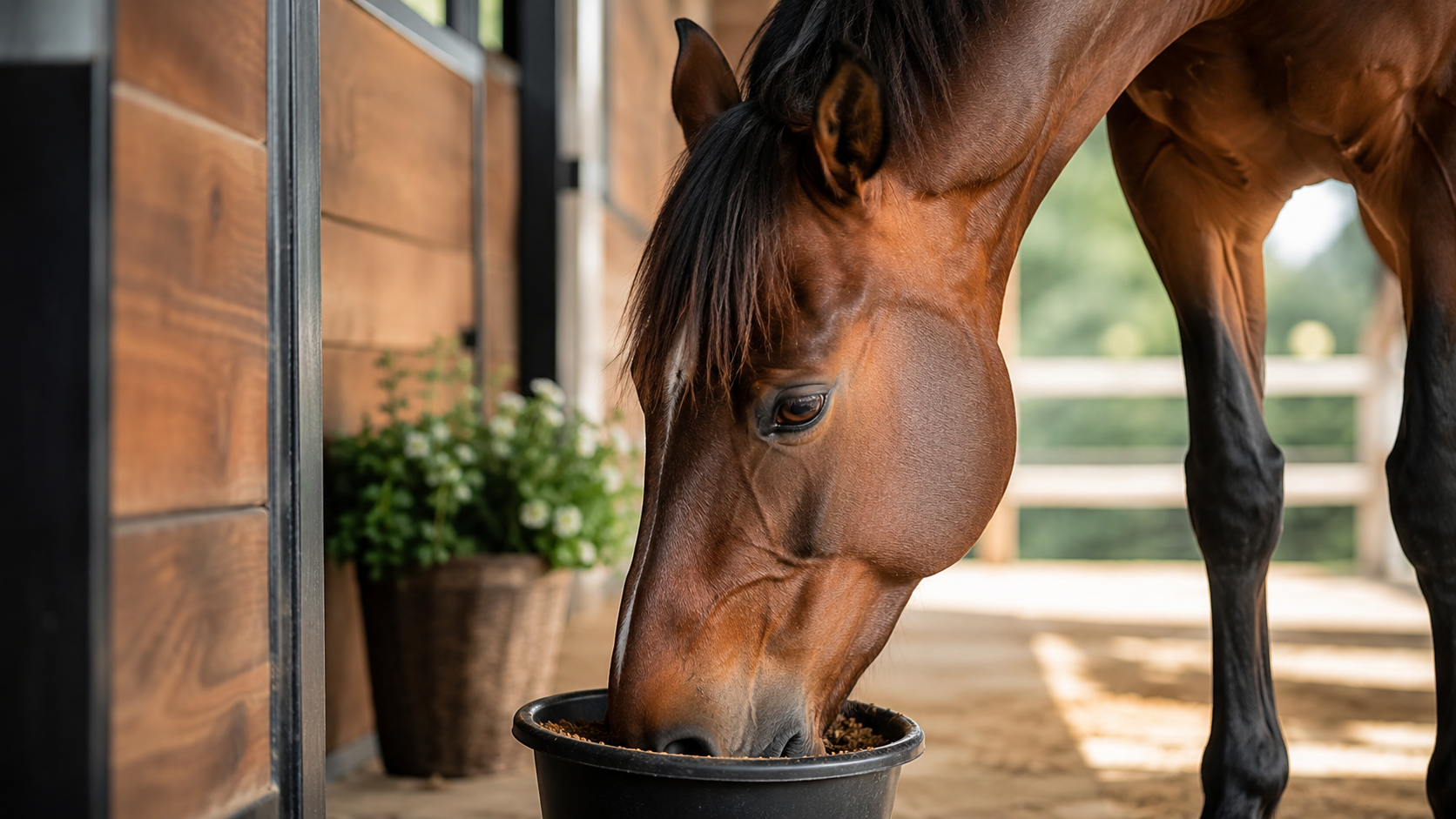
The Banker Horse has a very efficient metabolism, accustomed to limited and low-nutritional-quality food resources. It tends to become overweight if its diet is too rich. Its diet should be primarily based on coarse forage (good quality hay, grass) and requires very little, if any, concentrates, except in cases of intense work or specific needs (gestation, lactation).
Due to its efficient metabolism, the Banker Horse is potentially more susceptible to metabolic problems such as Equine Metabolic Syndrome (EMS) and laminitis if overfed or exposed to pastures too rich in fructans. Careful management of its weight and diet is crucial.
With Equio, every feed, supplement or treat is read against the horse's real profile (age, weight, Body Condition Score, conditions) — useful for a Banker Horse as soon as a metabolic or digestive sensitivity is known.
Health and points to watch
Regular weight monitoring is essential to prevent obesity and metabolic problems. Hooves, though robust, require regular trimming if the horse is domesticated. Particular attention should be paid to dental health, especially in older horses.
- More frequent conditions: laminitis (if overfed), dental problems (related to age or wild foraging)
Care and grooming
Domesticated Banker Horses require basic care similar to other hardy breeds. Hoof trimming is important to maintain their integrity. Their manes, tails, and coats do not require specific care; regular brushing is sufficient. They are generally weather-resistant and do not need clipping.
Did you know?
- Banker Horses are famous for their ability to drink brackish water, a unique adaptation to their island environment where fresh water is scarce.
- They are managed by organizations such as the Corolla Wild Horse Fund and the Cape Lookout National Seashore, which ensure their welfare and the preservation of their population.
- Each year, a limited number of foals are captured and put up for adoption to manage the population and prevent overpopulation on the islands.
The Banker Horse and how to track it
The Banker Horse breed is very rare outside its native range in North Carolina. There is no documented breeding or significant population of Banker Horses in France.
Equio lets you build a complete profile for a Banker Horse: identity, weight, Body Condition Score, feeding, conditions, care reminders (vaccines, worming, trimming) and an exportable health log. The breed sets the identity; everyday decisions still depend on the real horse and your vet's advice.
- Record the activity level: rest, leisure, sport or breeding
- Add known conditions or sensitivities
- Scan feeds, plants and care products
- Keep reminders (vaccines, worming, trimming)
- Prepare a PDF export before a vet appointment
Frequently asked questions
Can the Banker Horse be domesticated?
Yes, although most live in the wild, some individuals, particularly adopted foals, can be domesticated. They require patient and consistent training due to their independent nature.
What is the typical size of a Banker Horse?
Banker Horses are small, typically measuring between 132 and 142 cm at the withers, which often places them in the pony or small horse category.
Where can Banker Horses be seen?
Banker Horses primarily live on the barrier islands of North Carolina, particularly on the Outer Banks, in Corolla, and on Shackleford Banks. Guided tours are often offered to observe them in their natural habitat.
Are they an endangered breed?
Yes, the Banker Horse population is considered endangered due to their limited numbers and the fragility of their habitat. Conservation efforts are in place to protect the breed and its environment.
What is the cost of a Banker Horse?
The cost of a Banker Horse varies. Foals adopted through conservation programs may have symbolic adoption fees, while domesticated and trained horses can be more expensive, although they are rare for sale.