
Horse breed
Retuerta
The Retuerta breed is considered one of Europe's oldest and purest equine breeds, descending directly from wild horses of the Iberian Peninsula. It has survived thanks to its isolation in the Doñana Natural Reserve, in Andalusia.

The breed at a glance
The Retuerta is a hardy, intelligent, and resilient horse, accustomed to semi-feral life. It possesses a strong survival instinct and a great capacity for adaptation. Although wild, it can be trained and then proves courageous and enduring.
- Category
- hardy breed
- Origin
- Spain · Prehistoric / Ancient
- Height at withers
- 135–145 cm
- Weight
- 350–450 kg
- Lifespan
- 25-30 years
- Common coats
- bay, black, grey
Origin and history
The Retuerta breed is considered one of Europe's oldest and purest equine breeds, descending directly from wild horses of the Iberian Peninsula. It has survived thanks to its isolation in the Doñana Natural Reserve, in Andalusia. Its genetic purity has been confirmed by DNA studies, linking it to prehistoric Iberian horses. The breed has been officially recognized, and a conservation program has been established to preserve this unique genetic heritage.

Conformation and physique
A medium-sized horse, compact and robust, with strong bone structure and well-developed musculature, adapted to wild life. Its silhouette is that of a primitive horse, with great hardiness.
Medium-sized head, straight or slightly convex profile, with wide nostrils and expressive eyes. Ears are medium-sized and well-set.
Medium-length neck, strong and muscular, well-attached to the withers. The withers are not very pronounced, blending harmoniously into the back.
Short and strong back, straight and solid topline. Deep and wide chest, well-sprung ribs. Slightly sloped and muscular croup, with a low-set tail.
Strong and dry limbs, with well-defined joints and robust tendons. Hooves are hard and well-formed, adapted to difficult terrain. Feathering is generally sparse.
- Common coats: bay, black, grey
Temperament and aptitudes
The Retuerta is a hardy, intelligent, and resilient horse, accustomed to semi-feral life. It possesses a strong survival instinct and a great capacity for adaptation. Although wild, it can be trained and then proves courageous and enduring.
Gaits are energetic, supple, and balanced, with good ground cover. They are adapted to locomotion over varied terrain and foraging.
- Uses: Genetic conservation, Scientific studies on equine evolution, Ecological ecosystem management, Recreational riding (rarely, after training)
Feeding the Retuerta
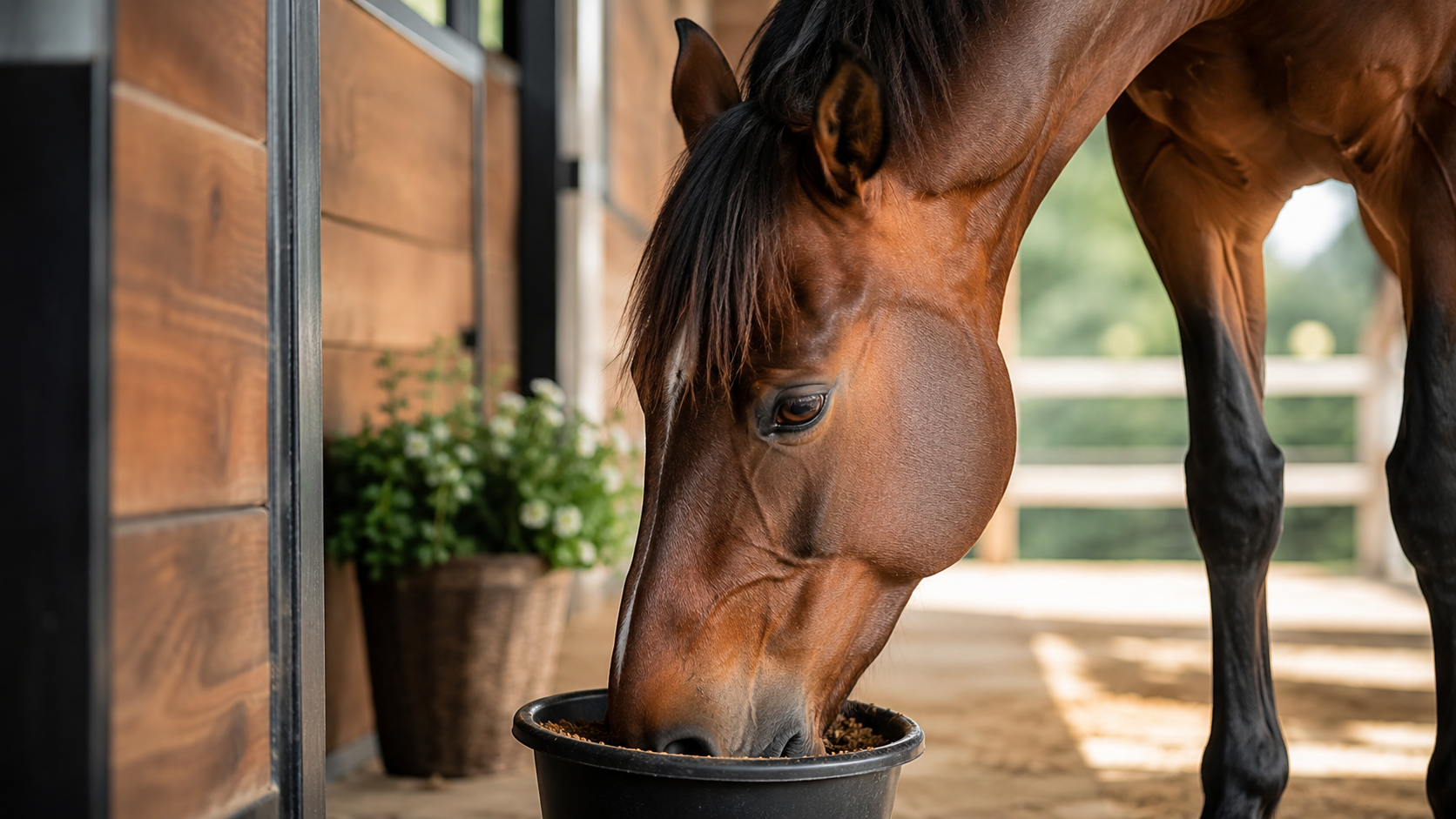
The Retuerta is an extremely thrifty horse, accustomed to feeding on poor and varied resources. Its metabolism is adapted to periods of scarcity, and it has a great capacity to utilize coarse forages. It requires few concentrates, even with light work, and can easily become overweight if its diet is too rich.
Due to its thrifty metabolism and adaptation to poor environments, the Retuerta could be predisposed to Equine Metabolic Syndrome (EMS) and laminitis if fed a diet too rich in sugars and starch, or if kept in an overly abundant environment without sufficient exercise. It is crucial to monitor its weight.
With Equio, every feed, supplement or treat is read against the horse's real profile (age, weight, Body Condition Score, conditions) — useful for a Retuerta as soon as a metabolic or digestive sensitivity is known.
Health and points to watch
The main concern is managing its diet in captivity to avoid obesity and metabolic disorders. Regular hoof monitoring is also important, even though they are naturally robust. Due to its hardiness, it is generally very resistant to diseases.
- More frequent conditions: Parasitism (in wild environments, but good natural resistance), Dental problems (related to age and natural wear)
Care and grooming
Care requirements are minimal for this hardy breed. Hooves are naturally hard and require regular trimming if the horse is in captivity and doesn't wear its feet down sufficiently. Mane and coat do not require special maintenance; occasional brushing is sufficient. Clipping is rarely necessary, except for medical reasons.
Did you know?
- The Retuerta is considered one of the most genetically pure equine breeds, with direct links to wild horses of the Pleistocene.
- It was rediscovered and identified as a distinct breed only at the end of the 20th century, after decades of isolation.
- Its name comes from the 'Retuerta', a grazing area in the Doñana Reserve where it was preserved.
The Retuerta and how to track it
The Retuerta breed is extremely rare and not bred in France. Its population is mainly confined to the Doñana Natural Reserve in Spain, with a few individuals in conservation programs elsewhere in Spain.
Equio lets you build a complete profile for a Retuerta: identity, weight, Body Condition Score, feeding, conditions, care reminders (vaccines, worming, trimming) and an exportable health log. The breed sets the identity; everyday decisions still depend on the real horse and your vet's advice.
- Record the activity level: rest, leisure, sport or breeding
- Add known conditions or sensitivities
- Scan feeds, plants and care products
- Keep reminders (vaccines, worming, trimming)
- Prepare a PDF export before a vet appointment
Frequently asked questions
Can the Retuerta be ridden or used as a working horse?
Although the Retuerta is a wild horse, it can be trained with patience and respect. It is then courageous and enduring, but its use is very limited outside of conservation programs. It is not suited for classic sports disciplines.
What is the current population of Retuerta horses?
The population is very small, estimated at a few hundred individuals, primarily in the Doñana Natural Reserve in Spain. It is an endangered breed and is the subject of significant conservation efforts.
Where can one see Retuerta horses?
Retuerta horses are primarily visible in their natural habitat, the Doñana Natural Reserve in Andalusia, Spain. Access is often regulated to protect the wildlife, but guided tours may allow for their observation.
Is the Retuerta an easy keeper?
Yes, it is an extremely hardy and low-maintenance breed. Its care and feeding requirements are minimal, provided its metabolism, adapted to poor environments, is respected. Excess food is its main enemy in captivity.
Is the Retuerta an aggressive breed?
As a wild horse, it possesses a pronounced flight and defense instinct. It is not inherently aggressive towards humans, but it is wary and requires a respectful and expert approach to be handled or trained.