
Horse breed
Australian Riding Pony
The Australian Riding Pony was developed from the 1950s in Australia, with the aim of creating a versatile and elegant sport pony. It originated from complex crosses between British pony breeds (Welsh, Dartmoor, Exmoor, Shetland) and light riding horses such as the Thoroughbred, Arabian, and English Riding Pony.

The breed at a glance
The Australian Riding Pony is renowned for its calm, intelligent, and willing temperament. It is easy to train, courageous, and eager to please, making it an excellent partner for young riders. It also possesses great stamina and a good ability to concentrate during work.
- Category
- pony
- Origin
- Australia · Mid-20th century
- Height at withers
- 122–148 cm
- Lifespan
- 25-30 years
- Common coats
- bay, chestnut, grey, black, palomino, dun
- Disciplines
- dressage, show jumping, eventing, hunter
- Other names
- Australian Riding Pony
Origin and history
The Australian Riding Pony was developed from the 1950s in Australia, with the aim of creating a versatile and elegant sport pony. It originated from complex crosses between British pony breeds (Welsh, Dartmoor, Exmoor, Shetland) and light riding horses such as the Thoroughbred, Arabian, and English Riding Pony. The breed was officially recognized in 1973 with the creation of the Australian Riding Pony Society. It quickly became a highly prized competition pony in Australia.

Conformation and physique
It is an elegant, athletic, and well-proportioned pony, with fine but strong bone. It has a harmonious build, resembling a miniature riding horse, with great distinction.
The head is refined, well-chiseled, with a straight or slightly concave profile. The eyes are large, expressive, and intelligent, the ears small and well-placed, and the nostrils wide.
The neck is long, well-arched, and set high, blending harmoniously into well-defined and extended withers. This promotes an elegant head carriage and good shoulder freedom.
The back is short and strong, the topline taut and muscular. The chest is deep and wide, providing ample room for the lungs. The croup is long, muscular, and slightly sloping, with a well-set tail.
The limbs are long, fine, and clean, with well-defined joints and clearly delineated tendons. The cannons are short and the pasterns of good length. The feet are small, round, and hard. Feathers are generally absent or very sparse.
- Common coats: bay, chestnut, grey, black, palomino, dun
Temperament and aptitudes
The Australian Riding Pony is renowned for its calm, intelligent, and willing temperament. It is easy to train, courageous, and eager to please, making it an excellent partner for young riders. It also possesses great stamina and a good ability to concentrate during work.
The gaits are expansive, supple, regular, and energetic, with good hindquarter engagement and great elasticity. The trot is particularly airy and the canter balanced, making it an excellent dressage and jumping pony.
- Uses: recreational riding, junior and youth competition, dressage, show jumping, eventing, show pony, driving
- Disciplines: dressage, show jumping, eventing, hunter, pony games, driving
Feeding the Australian Riding Pony
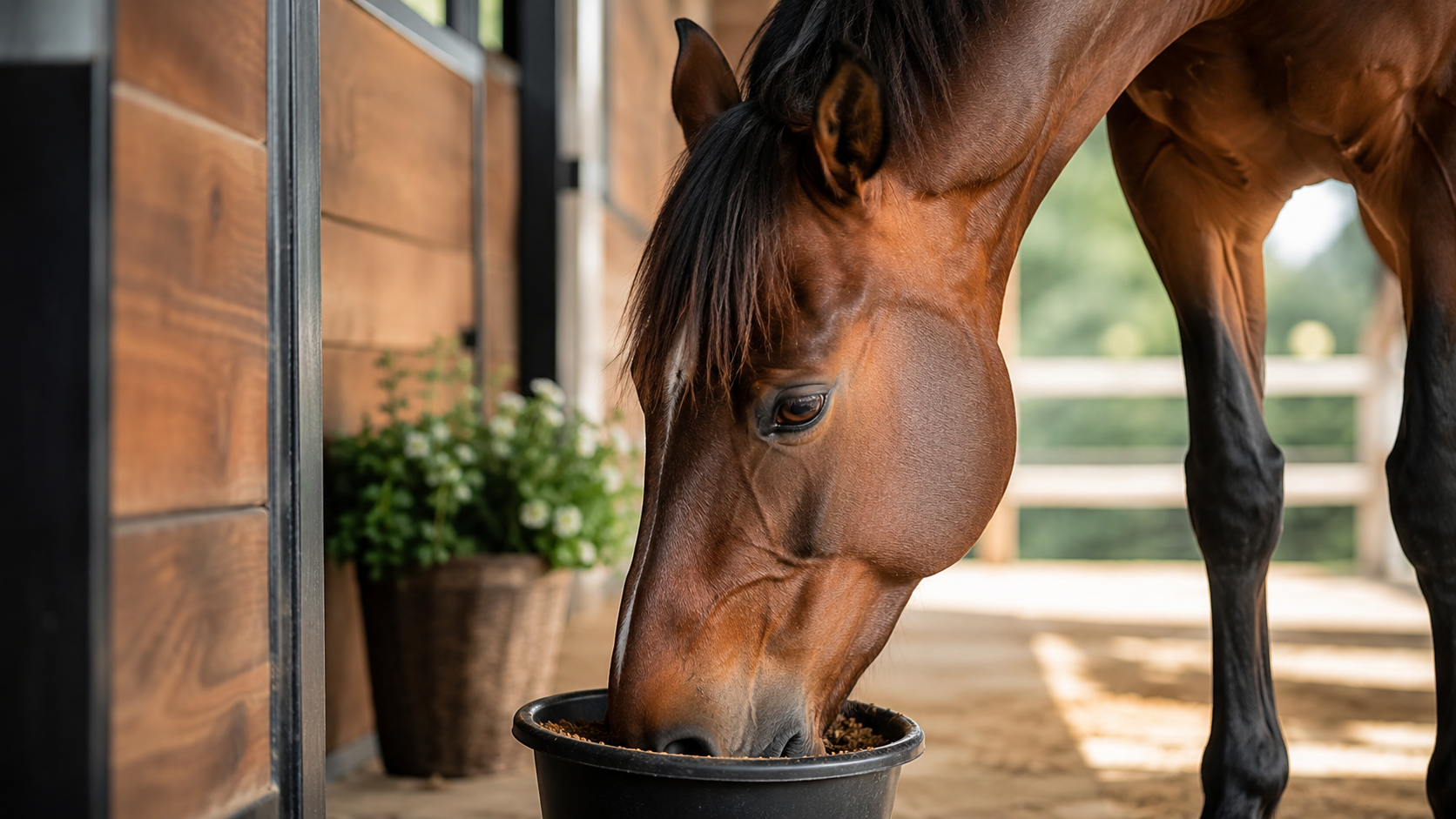
The Australian Riding Pony, resulting from crosses with 'hot blood' breeds, has a rather active metabolism. It requires a balanced diet, adapted to its activity level. Good quality forage in sufficient quantity is the basis of its diet. Concentrates can be added depending on the intensity of work, taking care not to overfeed to avoid obesity. It is generally less prone to obesity than more hardy ponies.
Although generally robust, like any equine, it can be sensitive to excesses of sugars and starch, potentially predisposing to laminitis or Equine Metabolic Syndrome (EMS) in cases of an unsuitable diet and lack of exercise. There is no documented predisposition to breed-specific metabolic pathologies such as PSSM.
With Equio, every feed, supplement or treat is read against the horse's real profile (age, weight, Body Condition Score, conditions) — useful for a Australian Riding Pony as soon as a metabolic or digestive sensitivity is known.
Health and points to watch
Particular attention must be paid to limb conformation and bone development in growing youngsters. Regular veterinary check-ups are recommended for early detection of any joint or tendon conditions, especially in sport ponies. Weight management is also important to prevent metabolic problems.
- More frequent conditions: osteochondrosis (OCD) in growing youngsters (as in many sport breeds), joint conditions associated with intense athletic activity
Care and grooming
Care is typical for a sport pony. Regular hoof trimming is essential to maintain good limb conformation. The mane and tail are generally left long and require regular brushing. The fine coat is easy to maintain, but clipping may be necessary in winter for ponies in work. Good skin hygiene is important, especially in hot and humid climates.
Did you know?
- The Australian Riding Pony is often described as a 'miniature riding horse' due to its elegance and sport horse gaits.
- It is very popular in Australia for pony club activities and young rider competitions, where it excels in many disciplines.
- Rigorous selection has allowed for the establishment of a very homogeneous type, despite the diversity of its foundation breeds.
The Australian Riding Pony and how to track it
The breed is not widespread in France, where it is mainly represented by a few imports for breeding or competition. It does not have a dedicated French studbook and remains a niche breed.
Equio lets you build a complete profile for a Australian Riding Pony: identity, weight, Body Condition Score, feeding, conditions, care reminders (vaccines, worming, trimming) and an exportable health log. The breed sets the identity; everyday decisions still depend on the real horse and your vet's advice.
- Record the activity level: rest, leisure, sport or breeding
- Add known conditions or sensitivities
- Scan feeds, plants and care products
- Keep reminders (vaccines, worming, trimming)
- Prepare a PDF export before a vet appointment
Frequently asked questions
What is the maximum height of an Australian Riding Pony?
The official maximum height for an Australian Riding Pony is 148 cm at the withers, which places it in the D-pony category. However, individuals may sometimes slightly exceed this height.
Is the Australian Riding Pony suitable for beginners?
Yes, thanks to its calm, intelligent, and willing temperament, the Australian Riding Pony is often considered very suitable for young riders and beginners. It is renowned for its kindness and trainability.
What are the main qualities of the Australian Riding Pony in competition?
In competition, the Australian Riding Pony stands out for its elegant and expansive gaits, jumping ability, versatility, and excellent temperament. It particularly excels in dressage, show jumping, and eventing for young riders.
Where can Australian Riding Ponies be found in France?
The Australian Riding Pony is rare in France. They can occasionally be found with specialized breeders or private individuals who have imported specimens. There is no large breeding establishment dedicated to this breed on French territory.
Is the Australian Riding Pony a hardy breed?
No, the Australian Riding Pony is not considered a hardy breed. It is a sport pony selected for its performance and elegance, requiring care and feeding adapted to its athlete status, although it is generally robust.