
Horse breed
Burmese Pony
The Burmese Pony is an ancient breed originating from the mountainous regions of Myanmar, particularly Shan State. Its history is closely linked to the local populations who have used it for centuries for transport and agricultural work.

The breed at a glance
The Burmese Pony is renowned for its calm, docile, and courageous temperament. It is very hardy, enduring, and hardworking, making it an excellent companion for work and trekking. It is also intelligent and easy to train.
- Category
- pony
- Origin
- Myanmar (Burma) · Ancient, probably pre-colonial
- Height at withers
- 100–130 cm
- Weight
- 150–250 kg
- Lifespan
- 20-25 years
- Common coats
- bay, chestnut, black, grey
- Disciplines
- Trail riding, Trekking, Light harness driving
- Other names
- Burmese Pony, Shan Pony
Origin and history
The Burmese Pony is an ancient breed originating from the mountainous regions of Myanmar, particularly Shan State. Its history is closely linked to the local populations who have used it for centuries for transport and agricultural work. Although its exact origin is poorly documented, it is considered a descendant of Mongolian and Tibetan ponies. The breed has not been subject to a structured breeding program until recently, and its official recognition is still under development.

Conformation and physique
It is a small, compact, and robust pony, with strong bone structure and well-developed musculature, adapted to difficult terrain. It has a rustic and enduring build.
The head is medium-sized, often with a straight or slightly convex profile. The eyes are expressive, and the ears are small and well-placed.
The neck is short, thick, and muscular, well-set, blending into a low but strong wither.
The back is short and strong, with a straight topline. The chest is broad and deep, providing good respiratory capacity. The croup is rounded and muscular.
The limbs are short, clean, and very strong, with well-defined joints and correct conformation. The hooves are small, hard, and resilient, adapted to mountainous terrain. Feathers are generally sparse.
- Common coats: bay, chestnut, black, grey
Temperament and aptitudes
The Burmese Pony is renowned for its calm, docile, and courageous temperament. It is very hardy, enduring, and hardworking, making it an excellent companion for work and trekking. It is also intelligent and easy to train.
The gaits are energetic, sure-footed, and regular, with good scope for its size. It is particularly agile and confident on uneven terrain.
- Uses: Transport of goods and people in the mountains, Light agricultural work, Children's mount, Equestrian trekking, Equestrian tourism
- Disciplines: Trail riding, Trekking, Light harness driving
Feeding the Burmese Pony
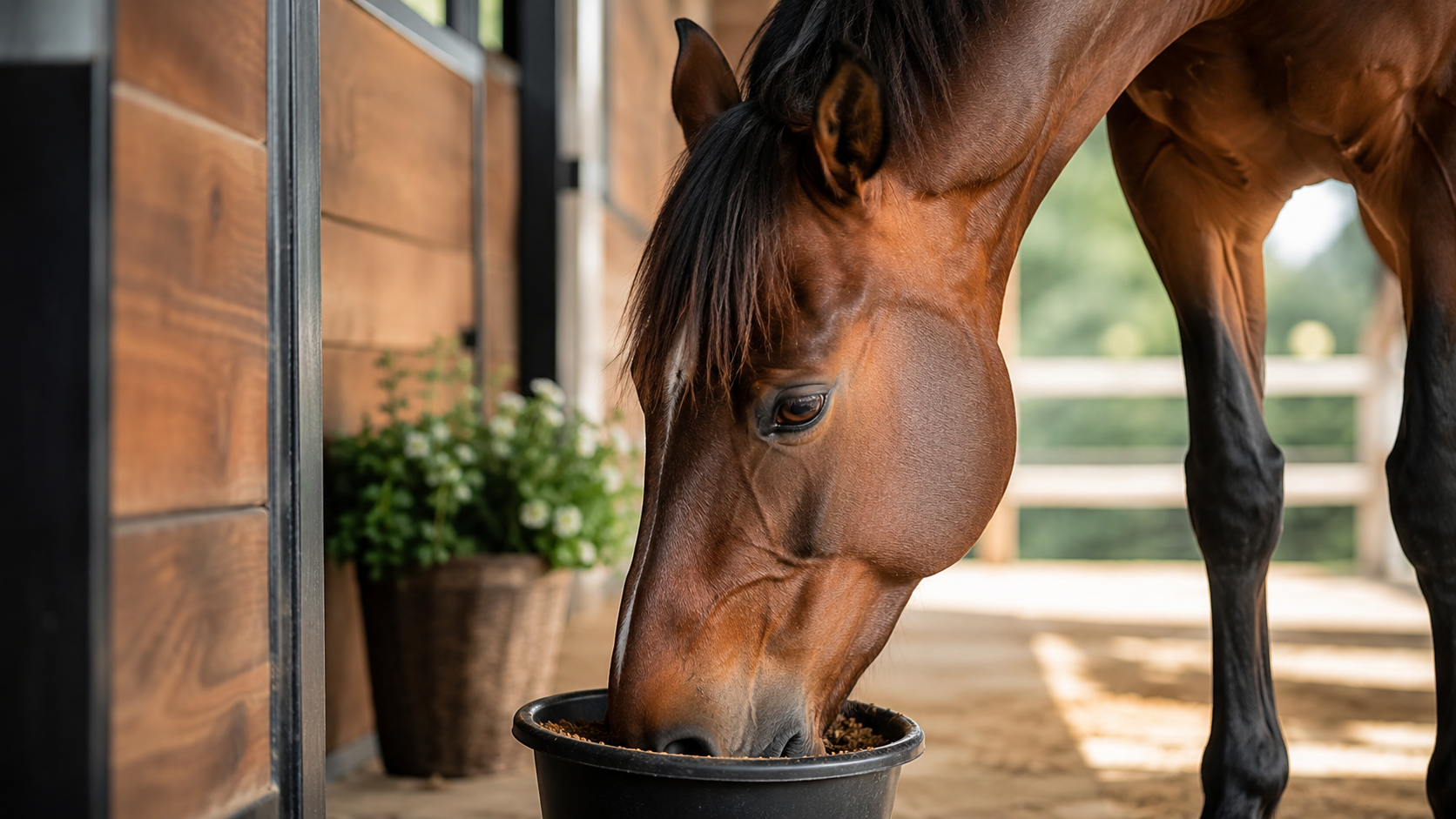
The Burmese Pony is a hardy and economical pony, accustomed to limited food resources. Its metabolism is efficient, making it prone to obesity if its diet is not controlled. It generally thrives on good quality forage (grass, hay) and only requires concentrates during intense work or for specific needs (gestation, lactation).
Due to its economical metabolism, the Burmese Pony can be predisposed to laminitis and Equine Metabolic Syndrome (EMS) if overfed or given unlimited access to rich pastures. Careful weight monitoring and an appropriate diet are essential.
With Equio, every feed, supplement or treat is read against the horse's real profile (age, weight, Body Condition Score, conditions) — useful for a Burmese Pony as soon as a metabolic or digestive sensitivity is known.
Health and points to watch
Particular attention must be paid to weight management to prevent laminitis and EMS. The hooves, although resilient, require regular trimming. Up-to-date deworming and vaccination are essential to maintain its good health.
- More frequent conditions: Laminitis (in case of overfeeding), Age-related dental problems, Gastrointestinal parasitism (if not managed)
Care and grooming
The Burmese Pony's hooves are naturally hard and resilient, but regular trimming is necessary to maintain their shape and prevent uneven wear. Its mane and tail are generally thick and may require occasional detangling. Its rustic coat does not require special care, apart from regular brushing to remove dirt and dead hair.
Did you know?
- The Burmese Pony is often used by local populations for transporting tea and other goods across the mountainous terrain of Myanmar.
- Its small size and robustness allow it to access areas inaccessible to motorized vehicles.
- It is a symbol of resilience and adaptation in its region of origin.
The Burmese Pony and how to track it
The Burmese Pony is a very rare breed in France and is not significantly bred there. A few individuals may exist with private owners passionate about rare or exotic equine breeds.
Equio lets you build a complete profile for a Burmese Pony: identity, weight, Body Condition Score, feeding, conditions, care reminders (vaccines, worming, trimming) and an exportable health log. The breed sets the identity; everyday decisions still depend on the real horse and your vet's advice.
- Record the activity level: rest, leisure, sport or breeding
- Add known conditions or sensitivities
- Scan feeds, plants and care products
- Keep reminders (vaccines, worming, trimming)
- Prepare a PDF export before a vet appointment
Frequently asked questions
Is the Burmese Pony suitable for children?
Yes, thanks to its calm, docile temperament and small size, the Burmese Pony is generally very well suited as a mount for children, provided it is well-trained.
What is the life expectancy of a Burmese Pony?
The Burmese Pony has a typical life expectancy of 20 to 25 years, and some individuals can live longer with good care and an appropriate diet.
Is the Burmese Pony easy to care for?
Yes, it is a hardy and economical breed. Its dietary needs are moderate, and it is generally robust. However, particular attention must be paid to preventing obesity and to regular hoof care.
Can Burmese Ponies be found in France?
The Burmese Pony is extremely rare in France. There is no structured breeding of this breed, and the individuals present are very few and often imported by enthusiasts.
What are the main qualities of the Burmese Pony?
Its main qualities are its hardiness, endurance, sure-footedness on difficult terrain, calm and docile temperament, and great adaptability.